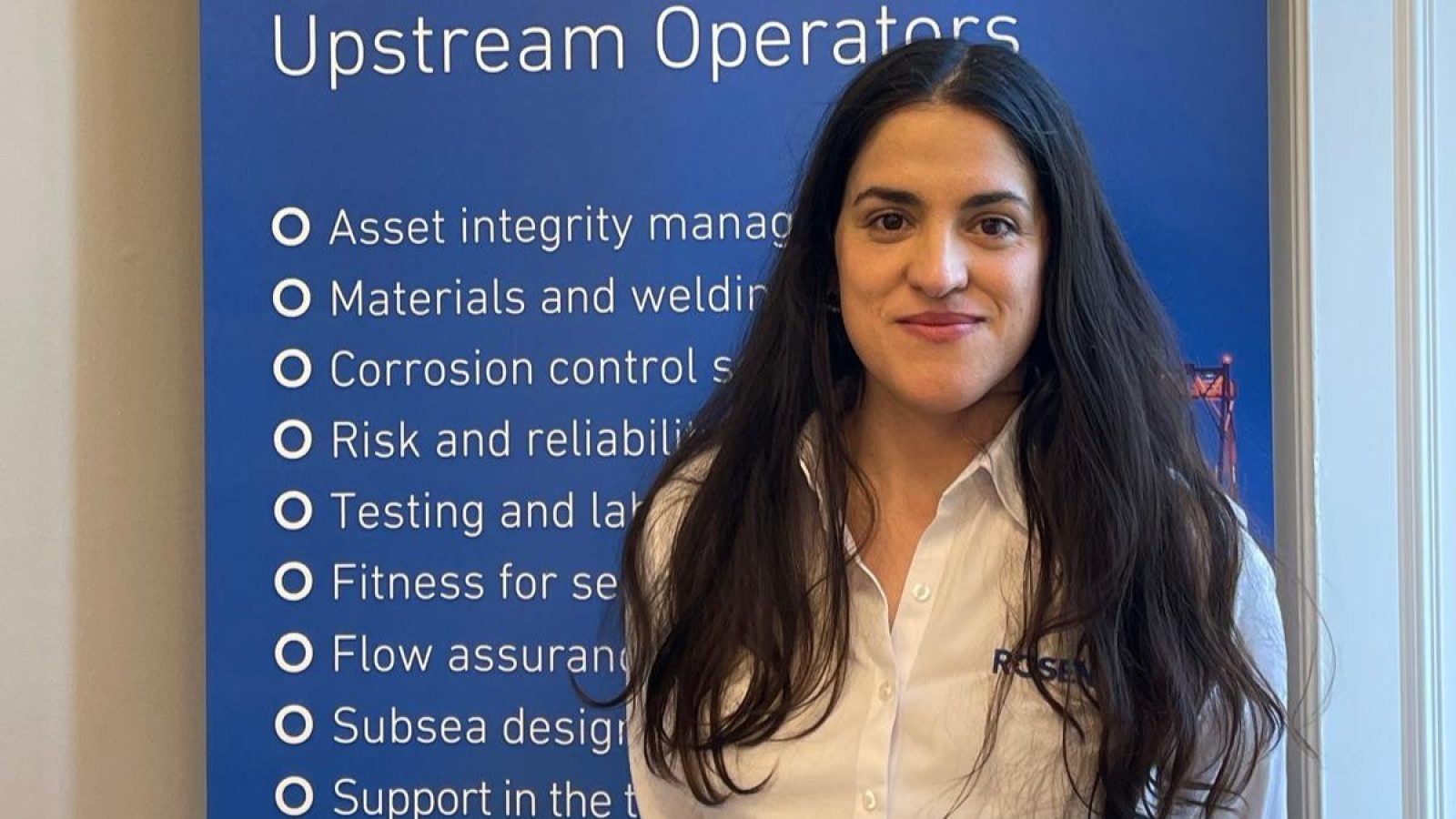
Pipeline engineering remains a male‑dominated field, but from ROSEN’s Aberdeen office, Senior Engineer Andreia Meneses is helping to change that narrative.
Andreia shares her insights on how she found her way into the industry, why pipeline engineering became her chosen profession, and how she has developed her technical expertise while working on some of the world’s most challenging offshore infrastructure. She also shares her advice for the next generation of young women considering careers in STEM.
The Accidental Path to a Meaningful Career
Pipeline engineering wasn’t something I consciously set out to pursue at the start of my career. I found my way into the discipline almost by chance while working as a project engineer in Portugal, where I began contributing to pipeline‑related work alongside my wider responsibilities. At first, it felt like just another part of the job, but that perspective didn’t last long.
I later moved to Aberdeen to complete a Master’s degree in Petroleum Production Engineering at Robert Gordon University (RGU), and it was hard to ignore the pull of the city’s strong offshore energy heritage. Being based in a hub internationally recognised as a hub for offshore energy, it was impossible not to absorb the scale and significance of the work happening around me. The North Sea has long been at the forefront of offshore engineering, and pipelines sit quietly but critically at the centre of that story.
As I became more exposed to the industry what began as accidental involvement quickly became even more compelling. The technical complexity, the emphasis on integrity and risk management, and the knowledge that decisions made today can influence assets for decades all resonated strongly with me. Over time, that initial curiosity evolved into genuine passion. Pipeline engineering stopped being something I worked on and became something I cared deeply about, shaping a career that I find both challenging and meaningful.
Today, I find myself at the heart of ROSEN’s Aberdeen office as a Senior Engineer, having worked here for nearly half a decade. I collaborate on both local and international projects with some of the most experienced engineers’ in the oil and gas industry, sharing expertise and knowledge to help contribute to a safe and sustainable future.
Women in Engineering
It comes as no surprise that engineering remains a predominantly male‑dominated industry. While the number of women entering engineering is gradually increasing, true balance and visibility are still very much a work in progress. Representation matters and seeing women succeed in technical and leadership roles helps challenge perceptions and reinforces that engineering is a viable, rewarding career for everyone.
But, meaningful change doesn’t happen by accident. It is driven by inclusive workplace practices, active mentorship, and early engagement with schools and universities. From my own experience, supportive teams and open professional environments make a tangible difference, not only in career progression but also in confidence, job satisfaction, and long‑term retention within the industry.
I have been fortunate to learn from and work alongside many outstanding female engineers who inspire me daily. Through my work in the industry, I hope to help show other young women that engineering is not only fascinating, but also a positive industry that can offer a rewarding, lifelong career. My key takeaway is this: when people feel seen, supported, and valued, they don’t just remain in engineering, they help shape its future.
Supporting the Next Generation of Pipeline Engineers
Alongside my technical role, I have been actively involved with the Young Pipeline Professionals Europe (YPPE) since 2021. The Young Pipeline Professionals Europe (YPPE) is a group of highly motivated young professionals working within the pipeline industry with the aim of knowledge sharing to ensure the longevity of the industry, addressing the industry’s skill shortage and foster relationships.
As a volunteer-based group, I currently sit on the YPPE board as ‘Group Lead - Value to Young Pipeliners’, focusing on ensuring that YPPE activities deliver meaningful professional development for early-career engineers. YPPE plays an important role in bridging the often-daunting gap between academia and industry through technical events, networking opportunities, and access to experienced professionals across the pipeline sector. For aspiring pipeline engineers, particularly those based in Aberdeen or entering the industry through the North Sea, this type of engagement can be transformative. It helps demystify the profession, provides visibility of real and varied career pathways, and reassures young professionals that there is no single “right” route to success in the industry.
Professional Development and Advice
One of the most valuable lessons I’ve learned throughout my career is the importance of choosing to work for organisations that genuinely invest in their people. Training, mentoring, and ongoing professional development make a real difference — not just to technical capability, but to confidence and long‑term career satisfaction. At ROSEN, I’ve had the opportunity to work on a wide range of diverse and technically challenging projects, supported by structured learning programmes and a strong culture of knowledge‑sharing across teams.
Being part of a global organisation while being based in Aberdeen has given me the best of both worlds; deep local industry insight combined with exposure to international best practice. That balance has been instrumental in my development and has reinforced the value of working in environments that prioritise learning and collaboration.
For engineers at earlier stages in their careers, and particularly for women considering a future in engineering within the energy sector, there are a few pieces of advice I would share:
- Build strong technical fundamentals: A solid grounding will give you confidence and credibility.
- Never hesitate to ask questions: Curiosity is a strength, not a weakness, and asking questions is one of the fastest ways to learn.
- Develop your professional network and seek out mentors: These relationships can provide invaluable guidance, perspective, and sometimes lead to unexpected opportunities.
- Remain adaptable: Engineering methods, regulations, and technologies evolve quickly, so a mindset of continuous learning is essential.
- Value your perspective: Diverse viewpoints lead to stronger engineering solutions. Don’t underestimate the impact of your contribution.
The Future of the Pipeline Industry
What excites me most about pipeline engineering right now is how dynamic the industry has become. One of the most significant developments in pipeline engineering today is the digitalisation of asset management. Advances in data integration, automation, and predictive analytics are transforming how assets are monitored and maintained, particularly for mature infrastructure such as that found in the North Sea. These tools support more proactive decision-making, improved safety outcomes, and more efficient use of resources.
At the same time, the industry is adapting existing infrastructure for emerging fuels. For Aberdeen and the wider North Sea region, this transition presents both challenges and opportunities, requiring new approaches to materials, design, and integrity management while building on decades of engineering expertise.
It’s also what makes this such an exciting time to join the industry. There is real momentum; new technologies, evolving strategies, and a growing need for skilled engineers who are curious, adaptable, and willing to shape what comes next. Being part of a sector that is actively evolving, while still rooted in decades of engineering expertise, is incredibly motivating and one of the reasons I find this field so engaging.
Closing Thoughts
My career in pipeline engineering has been shaped by exposure to opportunity, continuous learning, and collaboration with talented teams across the industry. Based in Aberdeen, I continue to work on projects that demand both technical rigour and practical decision-making - qualities that remain central to pipeline engineering as the local energy sector evolves.
For those considering a career in this field, particularly women and early‑career engineers, pipeline engineering offers far more than technical challenge alone. It provides the opportunity to do meaningful, impactful work, to develop skills that remain relevant across a changing energy landscape, and to play an active role in shaping the future of energy. It is a career built on responsibility, curiosity, and collaboration, and one that I would wholeheartedly encourage others to explore.