When we’re invited to discuss a project, the first question is almost always the same: what kit are you using?
I understand why people ask as hardware is tangible. You can check its specification, put it on a manifest, and feel you’ve done your due diligence. But after more than a decade delivering demonstrably accurate 3D measurement data from some fairly challenging environments — subsea, topside, offshore — I’ve found that the camera is rarely the reason a 3D scanning project succeeds or fails. The process around the camera is what determines the outcome.
The 3D scanning market has been noisy for years. Every system gets marketed on accuracy, and the brochures tend to say similar things. The result is that buyers often treat these systems as broadly equivalent and assume that more expensive equipment automatically means more reliable results. That assumption has cost people real money. We’ve been called in several times to resolve situations where an initial survey (using well-specified, expensive hardware) produced data that couldn’t actually be used for its intended purpose. Even worse is when the quality issues are unknown, and decisions are made based on poor quality 3D data, making the problem bigger than it was at the start!
The distinction that matters comes down to one question: can the accuracy of your data be demonstrated from the data itself, or are you relying on the fact that the equipment was calibrated beforehand?
At Viewport3, we embed accuracy verification directly into every dataset using physical references captured in the scene alongside the subject. The practical consequence is that anyone can pick up the data (years after capture) and independently confirm whether it’s accurate. No grey area.
This approach has produced some satisfying results. A North Sea operator needed fabrication-ready drawings for a waste separator replacement during a tight outage window. We captured the geometry on site, embedded dimensional verification in the dataset, and issued 38 pages of fabrication drawings. Not a single clarification request came back. Another client installed a subsea component on first attempt using data we’d extracted from old inspection video — footage that was never originally intended for 3D measurement.
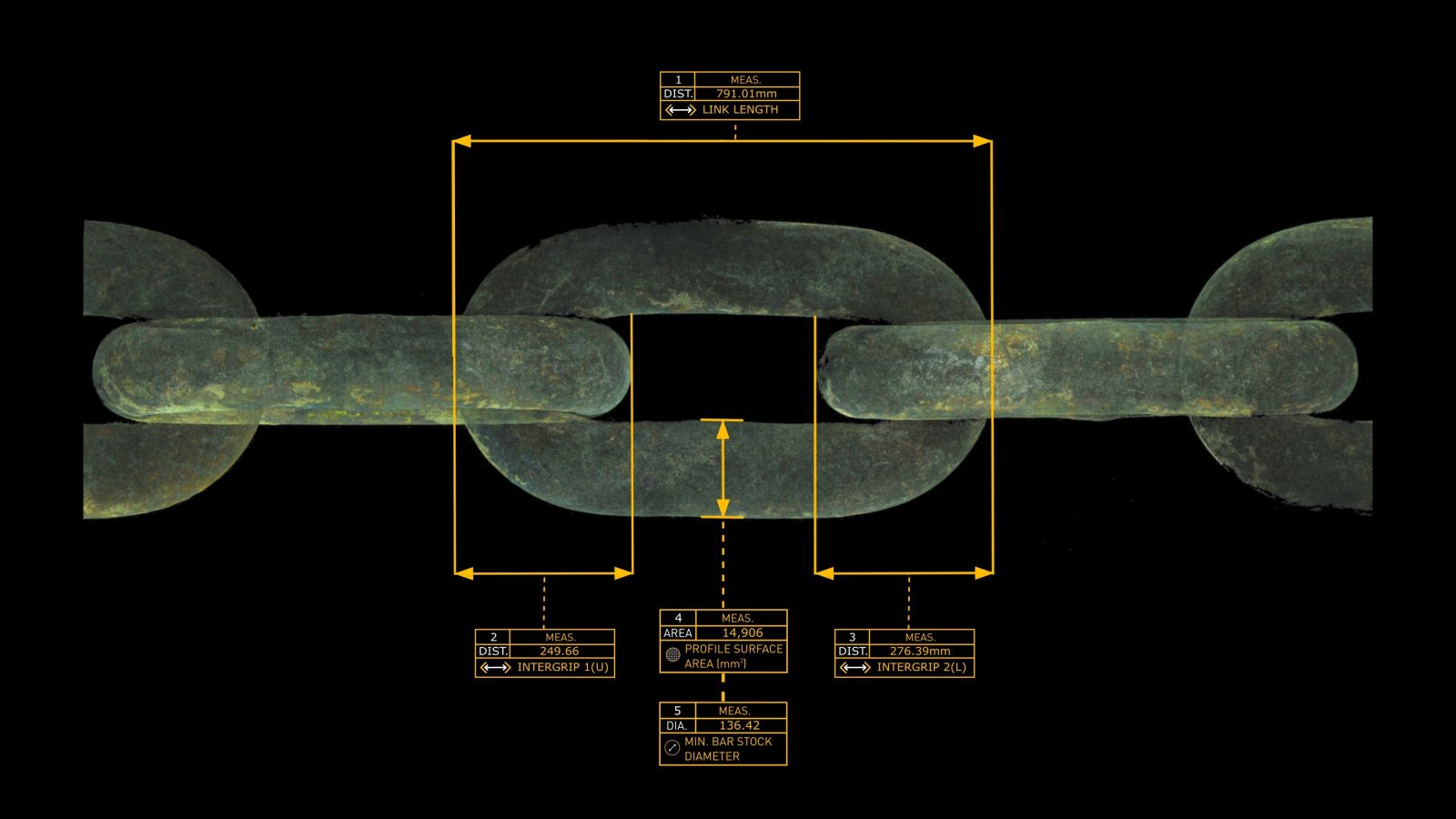
I think there’s a lesson here that applies well beyond our particular niche. Any business commissioning technical services (whether it’s measurement, testing, analysis, or inspection) would benefit from asking less about the equipment being used and more about the process that sits around it. A good process can produce excellent results from modest kit where circumstances require it. An absent process can waste the output of the most expensive hardware on the market.
So if you’re planning a project where dimensional certainty matters, the question worth asking isn’t what camera someone uses. It’s how they verify the accuracy of what they capture, and whether that verification lives inside the data, or only on a calibration certificate.
We’re always happy to have that conversation.
For context
Dimensional assurance is the practice of producing measurement data whose accuracy can be independently verified from the dataset itself. It matters wherever the consequences of a downstream decision is expensive — fabricating a component, mobilising a vessel, committing to a repair. When the geometry is trusted, teams build without contingency. When it isn’t, every step downstream carries unnecessarily high levels of risk.
Why photogrammetry? Photogrammetry — the technique of deriving 3D geometry from photographs — suits this work for a few specific reasons. It’s flexible enough to work in tight or awkward geometries where rigid laser or stereo systems can’t fit. And it delivers the resolution needed for detailed features like cracks or welds. It isn’t the right tool for every job. Sonar and laser systems play their part when the need suits their particular specialisms. The question is always which technique best answers the engineering question being asked.