Business and technology news is dominated by talk of AI, which promises to transform productivity and supercharge growth. But research suggests that many Scottish SMEs are struggling to unlock the full potential of AI tools.
A recent paper published by Sharp Europe found that 55% of small business leaders feel that their business is not utilising AI as much - or as effectively - as it should be and in some ways, this so-called ‘adoption gap’ is unsurprising: AI promises a lot, but onboarding innovative systems is technically challenging and surprisingly arduous.
SMEs in the North East often find that there’s a lot of work to be done preparing their infrastructure, cleaning up critical data and preparing proper guardrails, not to mention the need to onboard and train up staff. When the upfront cost is high - and the returns take months to manifest - it’s no wonder that business leaders are hesitant to dive in and start spending on expensive AI projects.
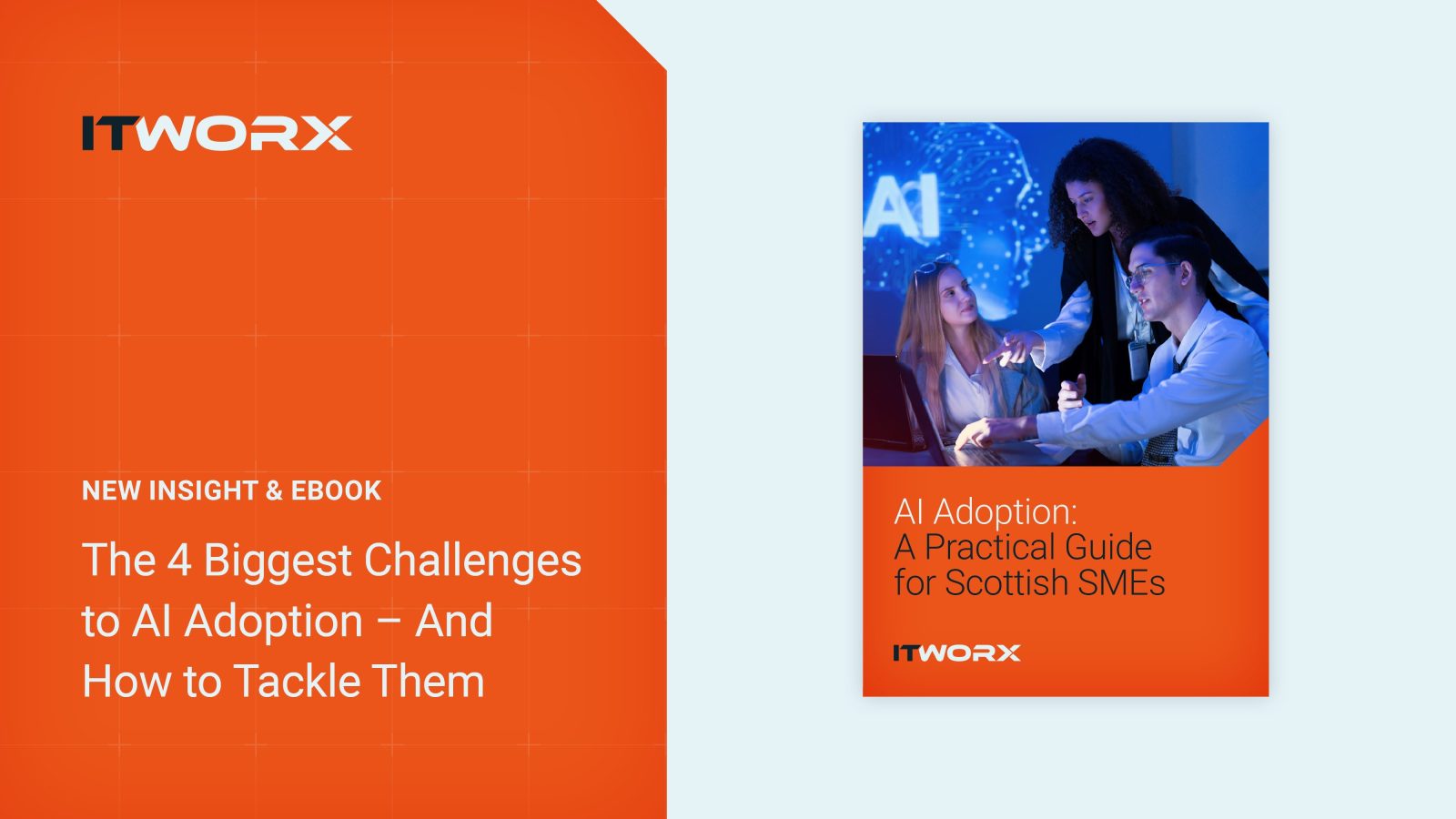
To reduce or remove some of these obstacles, ITWORX UK has put together a practical guide to AI adoption; drawing on our own experience to help SMEs in the North East of Scotland implement effective AI solutions that generate a measurable return on investment.
You can download the full guide here, or read on to start learning about the key preparatory work required to implement practical AI tools.
1. Preparing your infrastructure
It’s easy to underestimate the preparatory work required for successful AI adoption. Unfortunately, inadequate preparation is the number one reason that AI adoption projects run over-budget or fail to deliver on their promise.
Before you start thinking about the type of AI tool you’d like to deploy, or the business challenges you’d like to address, you need to make sure your infrastructure can support the technologies you want to implement.
AI magnifies existing strengths and weaknesses within your IT estate and it’s important to have a robust understanding of your infrastructure before you start. The easiest way to build this overview is to partner with an MSP that’s used to profiling IT estates, but if you do decide to undertake this process yourself, you’ll want to make sure you focus on mapping:
- Network infrastructure. Low latency, high bandwidth connections are critical to the performance of most AI tools.
- Physical hardware. You need high-performance computing resources, with decent processing power and/or modern GPUs to make the most of AI tools
- Cloud infrastructure. AI tools are resource hungry, and while you don’t need cloud infrastructure to use them, access to highly scalable, cloud platforms does improve your chances of successful adoption.
- Mission-critical data. AI tools are only as good as the data they’re trained on or allowed to crawl. Before onboarding any AI solutions, you’ll want to make sure that your data is clean and well-structured.
- Access controls and authentication systems. If you plan to grant staff access to company-wide models and tools this makes robust security protocols incredibly important.
Once you understand the potential vulnerabilities and limitations of your IT estate, you can work with a partner to plan any required upgrades and/or develop a digitalisation strategy that supports your ambitions.
2. Protecting Your Organisation From Risk
Good governance is the key to successful AI adoption. This is particularly true in the UK, where the regulatory environment and data protection obligations dial up the financial risk of unexpected behaviour.
Many AI tools, particularly generative platforms, process data externally. If employees input confidential customer information, commercially sensitive material or even their own personal data into uncontrolled systems, they expose the company to significant risks. It’s for this reason that every AI adoption strategy should clarify
- When and where data will be stored and processed
- Whether data from AI tools can be used to train external models
- Whether contractual safeguards will be provided by any solutions vendors
- What level of auditing can be carried out on AI interactions/outputs
Where AI interfaces with personal data, Data Protection Impact Assessments may be required, and it’s worth thinking about what sort of policy framework you’d like to create within your business too; will you select approved platforms, and limit employees from uploading certain types of data? Will you insist on regular human reviews and create a process for assessing the quality of AI output? Answering all these questions now will make things much easier when you start trying to select tools.
Want to know more?
If you think you’re ready to start picking tools and want a methodology for implementing your first pilot project, download the free ebook on practical AI adoption here.
If not, read on to learn about the remaining preparation required to onboard effective AI tools.
3. Getting the team on board.
Tools are only as effective as the people using them, and if your team isn't on-side, they won’t work to make your AI systems function efficiently. To this end Senior leadership must articulate a clear position on AI usage. As the London School of Economics points out in their article on leadership practices for successful AI transformation, good leaders communicate openly about AI initiatives and their intended impact.
It’s also important that leadership don’t look like they're handing down an indisputable mandate though: As the LSE report points out, involving employees in experimentation and decision-making is critical to getting buy-in from across the business.
In particular, you’ll need to think about how to message adoption throughout the organisation. Tackling concerns about redundancy or professional displacement is a great start, but you will need to think about a more refined comms plan designed to reduce speculation and support trust.
Acknowledging that AI automates repetitive administrative tasks, and releases capacity, while making it clear that you have a robust plan for redirecting staff and/or improving their day-to-day work is key to realising the full potential of any onboarding project.
4. Enabling your team
Messaging is part of the puzzle, but staff will also need training to start using AI tools productively. Whether it’s done via an external provider, an online learning portal or your own training/HR team, an effective enablement programme must include:
- Practical demonstrations using internal workflows
- Guidance on prompt design and critical evaluation
- Case studies relevant to departmental functions
Training should emphasise the limitations of AI systems alongside their capabilities. You’ll also want to ensure that training makes the staff fully aware of any security and/or legal vulnerabilities, and know how to handle data responsibly.
Want to know more?
The UK government offers free AI enablement training to all UK professionals via the Department for Science, Innovation and Technology. You can also find more practical tips by downloading our free ebook Practical AI Adoption for SMEs.
If you can take care of your infrastructure and data, policy framework and teams, you’ll be well positioned to start onboarding tools, but it is essential that you spend the time and effort required here, because inadequate preparation is the number one reason that AI adoption projects fail.