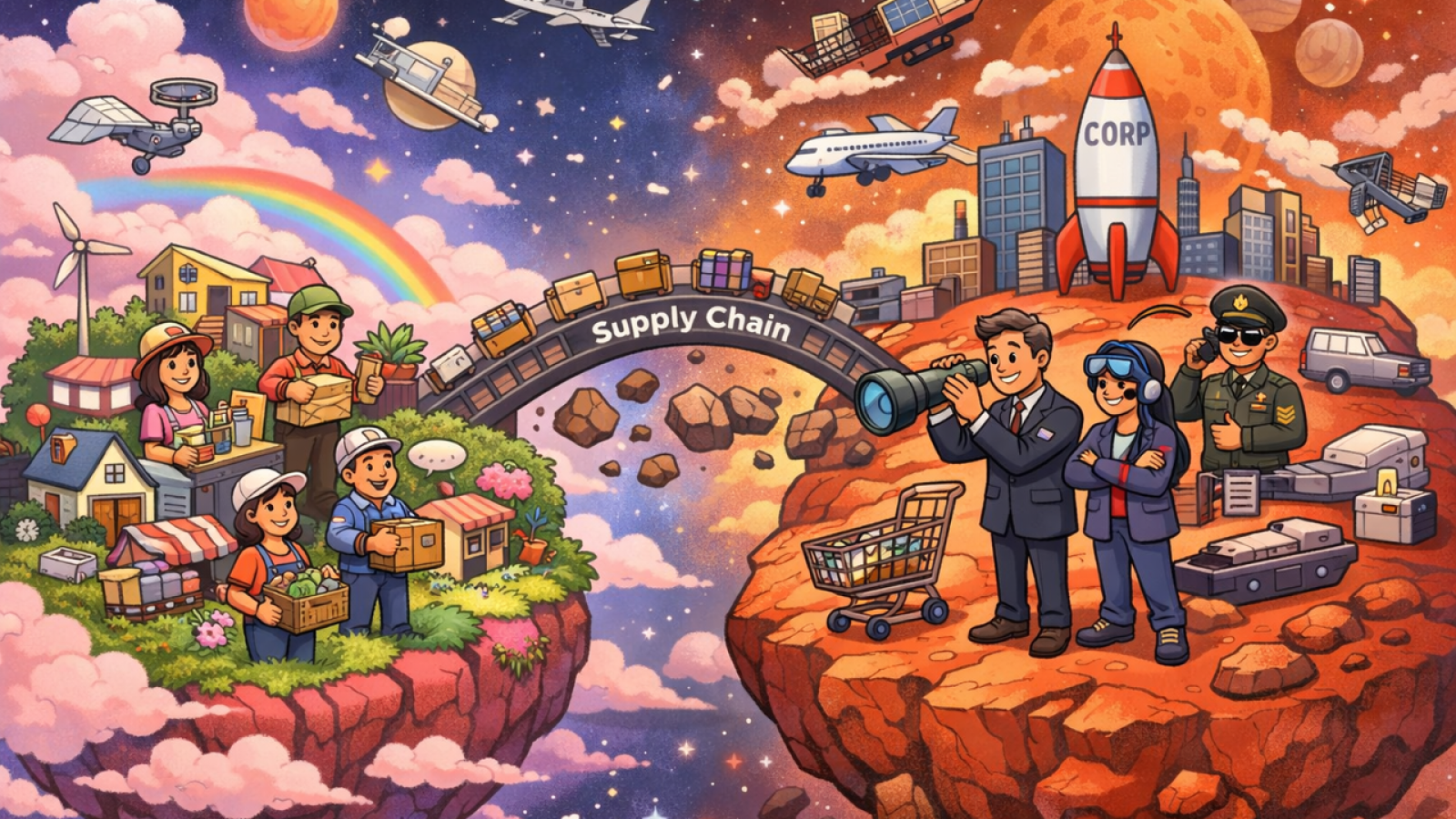
Much like John Gray's famous observation that men and women often seem to come from different planets entirely, anyone who has spent time on both sides of an extended supply chain may recognise a familiar comparison in that sometimes, it feels like multinationals and their vendors/suppliers might as well be communicating across interplanetary distances.
And yet, somehow, they need each other to survive.
The following, light-hearted comparison is very generalist, but hopefully the point comes across as intended.
Language
MARTIANS (Multinationals) appear to speak in the language of systems. They communicate through portals, platforms, and procurement tools with names that sound like space missions (Ariba, Coupa, SAP). They send invitations to tender that run into many pages, request compliance with 47 mandatory policies before a single conversation takes place, and measure relationship health through KPI dashboards reviewed quarterly by people who possibly have never visited a supplier's facility.
VENUSIANS (Vendors/Suppliers) speak the language of relationships. They communicate through WhatsApp messages at 7am, phone calls that get things done in ten minutes, and the accumulated trust of years of turning up when others didn't. They measure relationship health by whether someone picks up the phone.
Process
MARTIANS value process. A Martian will not approve an invoice without three-way matching, a goods receipt note, a compliant purchase order, and a partridge in a pear tree. The payment terms are 90 days, perhaps extended unilaterally to 120 during the last restructure, and the accounts payable team is often unreachable between Thursday and Sunday.
VENUSIANS value cash flow. A Venusian will quote a job, mobilise a team, deliver the work, and then spend the next three months navigating a supplier portal they were never properly trained on, chasing a payment that feels like it is funding the customer's working capital position rather than their own.
Value
MARTIANS want standardisation. Every supplier must look the same, behave the same, and be assessed through the same prequalification questionnaire, whether they are a global logistics provider or a two-person specialist engineering firm locally. Diversity of thought is celebrated in the annual report. Diversity of supplier type is quietly discouraged in procurement policy.
VENUSIANS want recognition. They want someone to acknowledge that they drove four hours to fix a critical piece of equipment on Christmas Eve. They want the relationship manager to still be in post six months after they signed the framework agreement. They want the scope not to change three times after the price was agreed.
Partnership
MARTIANS speak of partnership. It appears in every supplier conference presentation, usually on a slide with a Venn diagram and a stock photo of two people shaking hands above a city skyline. Partnership means the vendor shares the risk, absorbs the cost increases, and maintains contingency capacity just in case.
VENUSIANS live partnership. They sub-contract to their own network, carry buffer stock they were never asked to carry, hire people based on a verbal assurance of volume, and quietly cross-subsidise the Martian's project from margins earned elsewhere. Because the relationship matters and they hope it will improve.
Strategy
MARTIANS think strategically across 5-year horizons. Then they seem to reorganise every 18 months, change their category management structure, and the new VP of Procurement has a different philosophy entirely.
VENUSIANS think about next month's payroll.
And yet they need each other.
The MARTIAN cannot build, maintain, decommission, deliver, or innovate without the VENUSIAN ecosystem that surrounds them. Strip away the supply chain and the multinational is just a head office with a good logo.
The VENUSIAN cannot scale, develop, or sustain without the volume and consistency of the opportunities that the MARTIAN provides.
The problem is not that they are different. The problem is that neither fully understands the commercial reality the other operates within. The Martian writes contract terms without always understanding what they cost the Venusian to absorb. The Venusian often signs contract terms without fully understanding the exposure they are accepting.
The solution, as with most relationship challenges, is not to pretend the differences don't exist.
It is commercial awareness on both sides of the equation. It is multinationals understanding that their behaviours have real consequences downstream. It is suppliers understanding that what they sign, they own.
It’s learning to understand and speak each other's language, before the relationship ends in expensive litigation rather than a long and productive partnership.
Because in every supply chain, there is always a better deal available, for both planets, when the time is taken to truly understand each other and strive for a balanced relationship
Q. Which planet are you from and what's the most memorable moment of interplanetary miscommunication you've experienced?