We live in a world increasingly driven by data.
Businesses analyse customer behaviour. Public bodies publish performance reports. Charities measure impact. Employers monitor workforce diversity. Every sector is under pressure to demonstrate that decisions are evidence-based.
But there is a question we rarely ask:
Who is missing from the evidence?
Over the past year, our team at Influence Charity has reviewed thousands of pages of publicly available information, including Freedom of Information responses, Equality Impact Assessments, official statistics and policy documents. We did not set out to prove a particular argument. Instead, we asked a simple question: what might we be overlooking?
Again and again, we found the same challenge. The information organisations collect is often extensive, but it cannot always tell the whole story. Some communities are under-represented in consultations. Some barriers are difficult to measure. Some experiences never appear in the reports that influence investment, policy and service design.
That is not necessarily because organisations are failing. Rather, it reflects an important reality: data can only describe what is measured.
For businesses, this matters more than we might think.
An employee who quietly leaves because they never felt included may never appear in an equality report. A customer who abandons an online service because it is difficult to use may disappear from the data before their experience is understood. A community that rarely participates in consultations may become less visible in future decision-making, despite having important perspectives to share.
Evidence is essential. But evidence also has limits.
Recognising those limits does not weaken decision-making—it strengthens it. Asking who is absent from the picture encourages organisations to look beyond the headline statistics and consider whether there are voices, experiences or barriers that deserve greater attention.
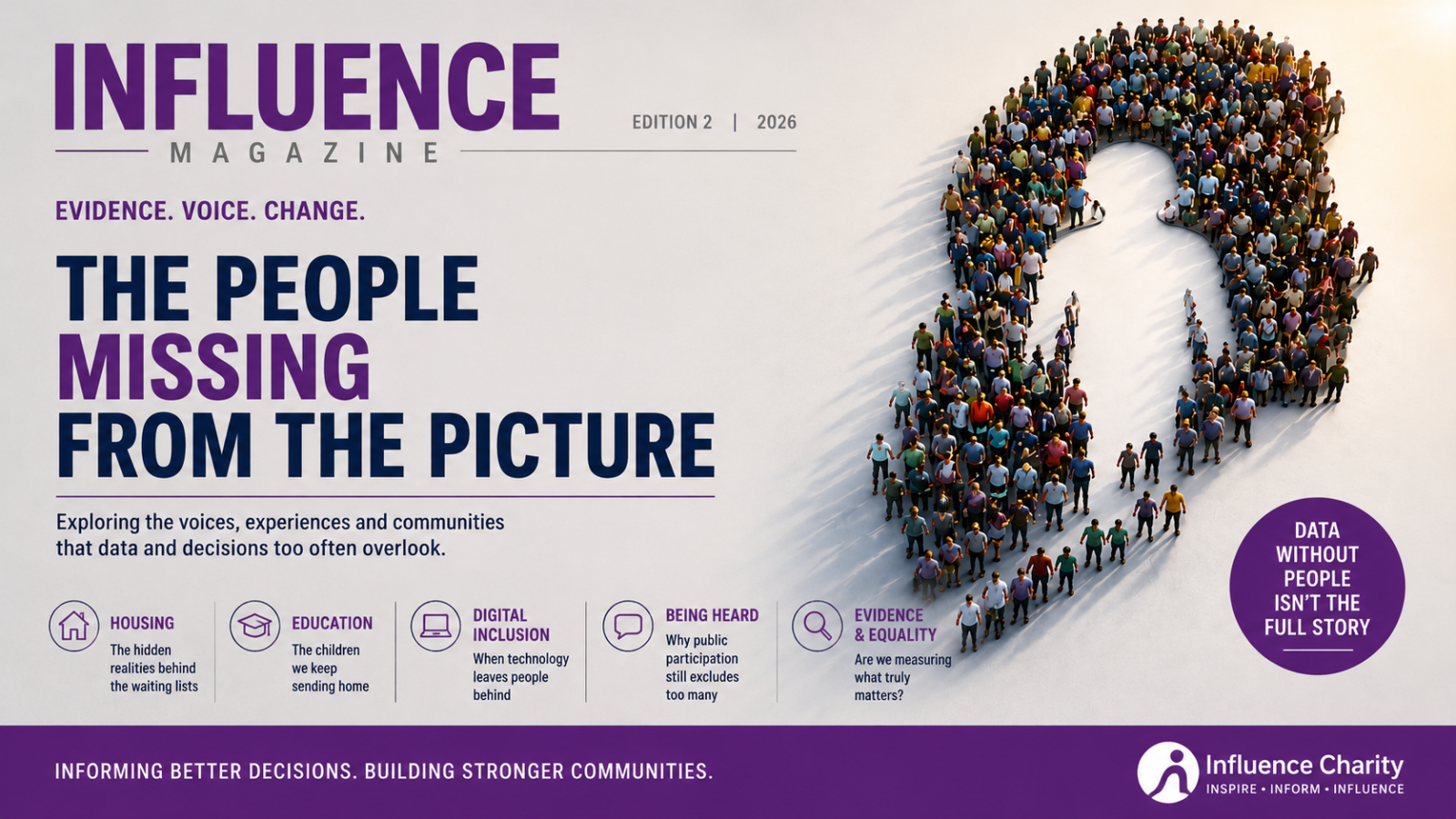
These questions inspired the latest edition of Influence Magazine, The People Missing From The Picture. Drawing on publicly available evidence, the magazine explores topics including housing, education, digital inclusion, public participation and equality. It does not claim to have all the answers. Instead, it invites readers to ask better questions.
As Aberdeen continues to grow and evolve, our greatest opportunity may not be collecting more data, but using existing evidence more thoughtfully and ensuring that we remain curious about what it does not yet reveal.
So I would like to leave you with one question.
Who is missing from your organisation's picture?
If that question has made you pause, I invite you to download the latest edition of Influence Magazine and join the conversation. We are also inviting residents, businesses, charities and public sector organisations to share examples of barriers, overlooked issues or voices they believe deserve greater attention. Together, we can help ensure that evidence informs decisions—and that no community becomes invisible simply because its story was never measured.
Read the latest edition of Influence Magazine:
Download free at: www.influence-charity.co.uk/magazine
Share your views:
What do you think is missing from Aberdeen's picture?
Complete our short community survey and help shape future editions of Influence Magazine.