An Aberdeen business is using cutting-edge artificial intelligence research to unlock valuable information hidden in decades of archived waste records.
William Nicol, the family-run trusted leader in transport, industrial and engineering services, has partnered with Robert Gordon University (RGU) on a 36-month industry-sponsored PhD studentship to explore how artificial intelligence (AI) and Large Language Models (LLMs) can transform unstructured documents into accessible, usable knowledge.
The partnership has supported an industry-sponsored PhD research project investigating how Case-Based Reasoning (CBR) can be combined with LLMs and Retrieval-Augmented Generation (RAG) to improve the accuracy and relevance of AI-generated responses. The company has contributed financial support of PhD student Lasal Jayawardena to enable the research and delivery of the project.
The company is supporting PhD researcher Lasal Jayawardena, a member of RGU’s Artificial Intelligence & Reasoning (AIR) Research Group, whose research is supervised by Professor Nirmalie Wiratunga and Dr Ikechukwu Nkisi-Orji.
For William Nicol, the research has been applied to a very real-world challenge: how to make use of the vast quantities of information contained within historic waste documentation.
Waste businesses are required to retain records, meaning that over time organisations can accumulate thousands of documents, notes and records that contain valuable operational information but can be difficult and time-consuming to search.
The research has explored how those records can be uploaded in bulk, with AI extracting and structuring the information contained within them and creating a searchable knowledge base.
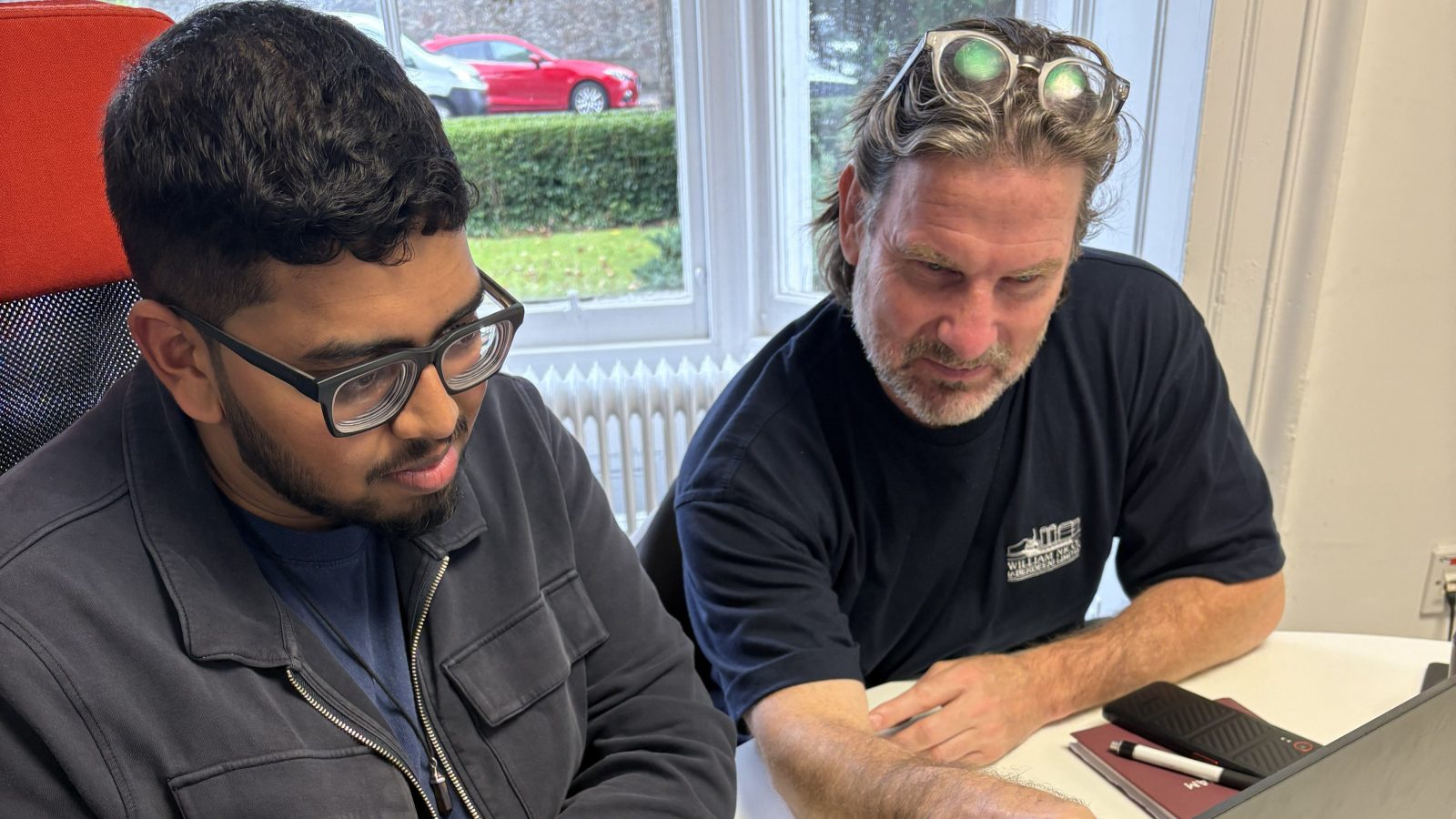
Left to right - PhD researcher Lasal Jayawardena, a member of RGU’s Artificial Intelligence & Reasoning (AIR) Research Group and Darren Nicol, Managing Director of William Nicol.
Instead of manually working through archive boxes and individual documents, users can then interact with the information conversationally — effectively ‘chatting’ with years of historic business data to find the answers they need.
The potential applications are significant, from identifying how long particular jobs have taken historically to extracting information required for regulatory reporting and other business processes.
It also demonstrates how the same approach could be applied far beyond waste, helping organisations unlock knowledge held in large volumes of existing, unstructured documentation.
The underlying RGU research is designed to enable information to be extracted from documents, identify relationships and similarities within that information, and then use the most relevant material to generate contextually appropriate responses through an LLM.
Unlike a conventional AI chatbot that relies on its pre-existing knowledge, the approach uses Retrieval-Augmented Generation to retrieve relevant information from a defined dataset before generating a response. This helps ground the response in the source material and addresses one of the key challenges associated with LLMs — the potential for inaccurate or fabricated information, commonly known as ‘hallucinations’.
Darren Nicol, Managing Director of William Nicol, says, “The starting point was a very simple question: what if we could actually use all the information sitting in our archives? Businesses have accumulated huge amounts of knowledge over the years, but much of it is locked away in documents and filing systems. It might be retained because it has to be, but that doesn't mean it is easy to access or learn from.”
Darren continues, “What this research has shown is that we can start turning that information into something genuinely useful. Instead of searching through individual documents, you can ask questions of the data and get meaningful answers based on the information contained within your own records. That's where I think the real potential of AI lies — not simply generating content but unlocking knowledge that businesses already have and turning it into something they can actually use.”
The research is being undertaken as part of an interdisciplinary iPhD project at RGU, with the wider research programme designed to develop a general platform for AI-driven decision support and demonstrate its application across different industry datasets.
Professor Nirmalie Wiratunga, Associate Dean for Research at RGU’s School of Computing, Engineering and Technology, lead of the AI & Reasoning Research Group and Lasal’s principal supervisor, says, “What is particularly exciting about this project is the opportunity to transfer our Case-Based Reasoning research into a real industrial setting. By combining CBR with Retrieval-Augmented Generation, AI systems can reason from relevant past examples rather than treating every document in isolation.
This is especially useful where a document may belong to several categories at once, because approaches that worked for similar previous documents can be reused for new ones. Reasoning from prior cases can improve these decisions while providing a clearer, traceable basis for them - an important step towards AI that is more transparent, explainable and trusted in real-world applications.”
For William Nicol, the collaboration represents an opportunity to combine academic research with practical industry challenges — using emerging technology to solve problems that businesses have faced for years.
The company believes the approach could ultimately be applied to almost any organisation holding significant volumes of historic, unstructured information. From archived operational records and compliance documentation to technical reports and other business records, information that was previously difficult to access could become an interactive source of insight.
The research has also gained international academic recognition, with Lasal Jayawardena presenting the work at the International Conference on Case-Based Reasoning (ICCBR 2026) in Bremen, Germany, and the European Conference on Machine Learning and Principles and Practice of Knowledge Discovery in Databases (ECML PKDD 2026) in Naples, Italy, as an example of emerging applications of AI and Large Language Models.
Darren Nicol, Managing Director of William Nicol, is a co-author of the academic research paper arising from the project.