People struggling to access legal advice, communities facing barriers to healthcare, and individuals unable to exercise rights that already exist in law are among the challenges a new research centre at Robert Gordon University (RGU) aims to address.
Bringing together experts in law, sociology, psychology and social work – the Centre for Legal Rights, Social Justice and Inclusion (CLaRION) will work with communities, policymakers and practitioners to turn research into practical solutions that improve lives.
The new Centre responds to inequalities in Scotland and beyond by addressing issues including human rights, poverty, barriers to healthcare, and the impacts of climate change. By bringing together academic expertise with the experience of legal professionals, community organisation and policymakers – CLaRION aims to bridge the gap between rights recognised in law and the rights people experience in everyday life.
The centre is being led by Dr Sarah Sivers and Dr Uche Iloka from RGU’s School of Law and Social Sciences, who will oversee the centre's programme of research and engagement activities.
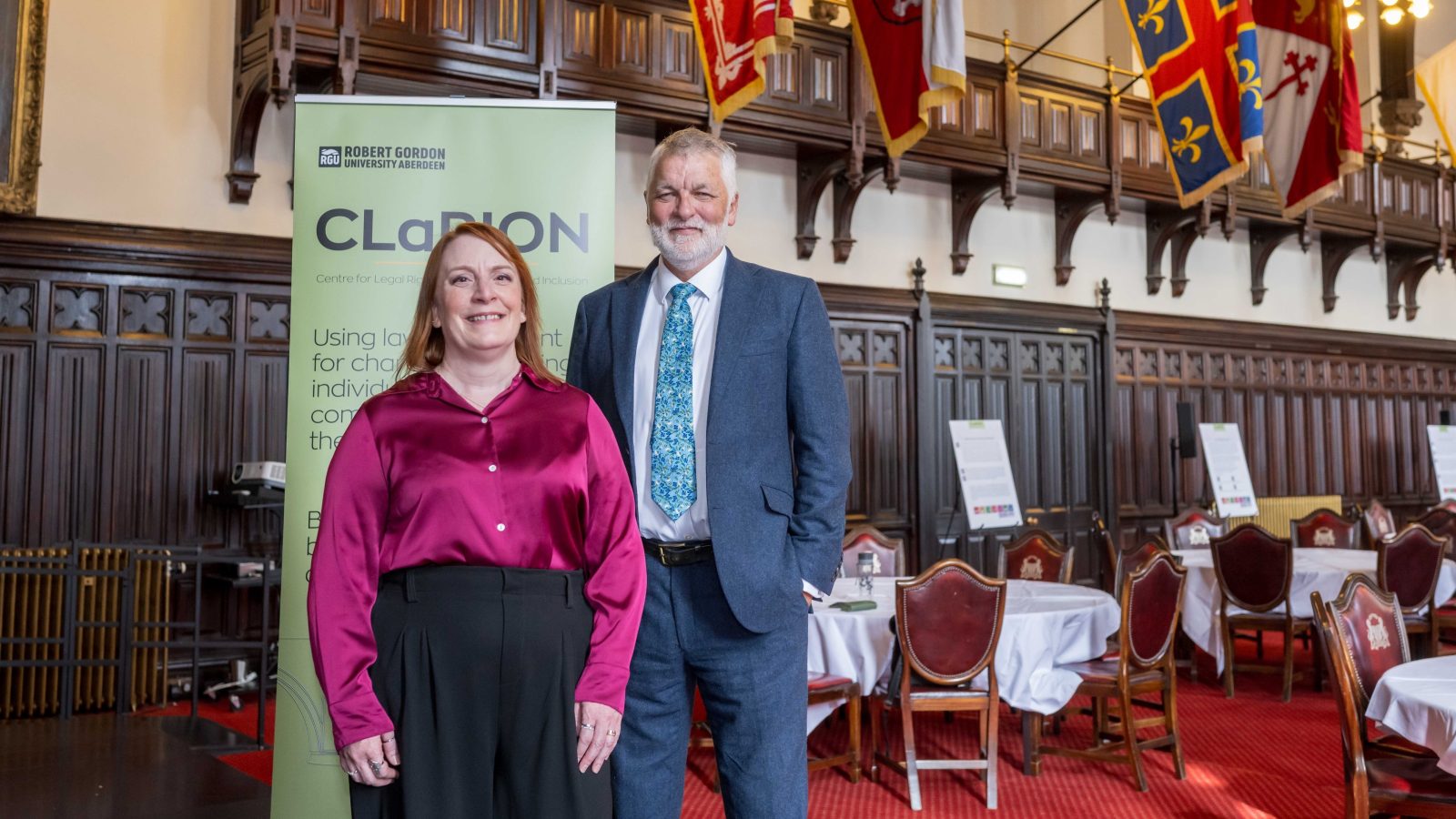
Dr Sivers said: “By connecting individual experiences with wider systemic issues, CLaRION aims to contribute to meaningful and lasting social change.
“Many of us will face huge legal and human rights challenges throughout the course of our lives and a lot of these barriers can be addressed by ensuring the necessary advice, knowledge and research is available to those who need it most.
“CLaRION has a real opportunity to be right at the very heart of social change in Scotland, with the expertise we have already, I’m sure the centre will prove to be a useful addition to the nation’s civic discussion moving forward.”
Speaking at the CLaRION launch, Aidan O Neill KC said: "Ultimately our work as lawyers is only of true worth – for ourselves as much as for others - when it contributes to the creating and strengthening of communities with a view to the better realisation of a society, bound and bonded by just laws."
"It is when and if we adopt a vision of the law as a means whereby we - as and in a community - seek to realise however imperfectly this form of justice, then our work as lawyers becomes the work of bridge builders."
Placing legal rights, social justice, and inclusion at the heart of its research, the centre is founded on the principle that legal rights have the greatest impact when people are able to understand, access and rely on them in their everyday lives. By combining traditional legal research with socio-legal approaches researchers ensure CLaRION’s work remains relevant, rigorous, and focused on real-world outcomes.
The centre's research focuses on three key areas:
- Improving access to justice.
- Enabling individuals and communities to exercise their rights.
- Challenging legal and structural barriers that prevent rights from being realised.
CLaRION will work with a wide range of partners to co-produce research that informs policy, supports communities, and helps strengthen access to social justice.
The Centre was officially launched at Aberdeen Town House with keynote speaker Aidan O’Neill KC, one of Scotland’s most respected legal figures and the current Scottish Legal Awards Lawyer of the Year.
CLaRION is one of nine Research and Innovation Centres established by RGU to bring together expertise, research and external partnerships to deliver real-world impact and support the University’s vision to be the UK’s leading work-integrated university.