This Spring, a major exhibition of original artefacts from the RMS Titanic will be presented in Aberdeen, as White Star Heritage brings its acclaimed collection to P&J Live from 26 March to 12 April 2026.
The exhibition places rare and often deeply personal objects at the centre of the Titanic story, offering visitors a direct physical connection to the ship, its passengers, and its final voyage.
Special exhibits include:
The William Henry Harrison Letter
Among the most significant items on display is a rare original letter written aboard Titanic by William Henry Harrison, private secretary to J Bruce Ismay, chairman of the White Star Line. Written during the voyage, the letter provides an unusually detailed account of daily life and working conditions aboard the ship. Its poignancy is heightened by Harrison’s expressed hope for a future shore-based role, a future he would never see, having perished in the sinking. As a firsthand document created aboard Titanic itself, the letter stands as one of the most intimate surviving testimonies of life on the ship.
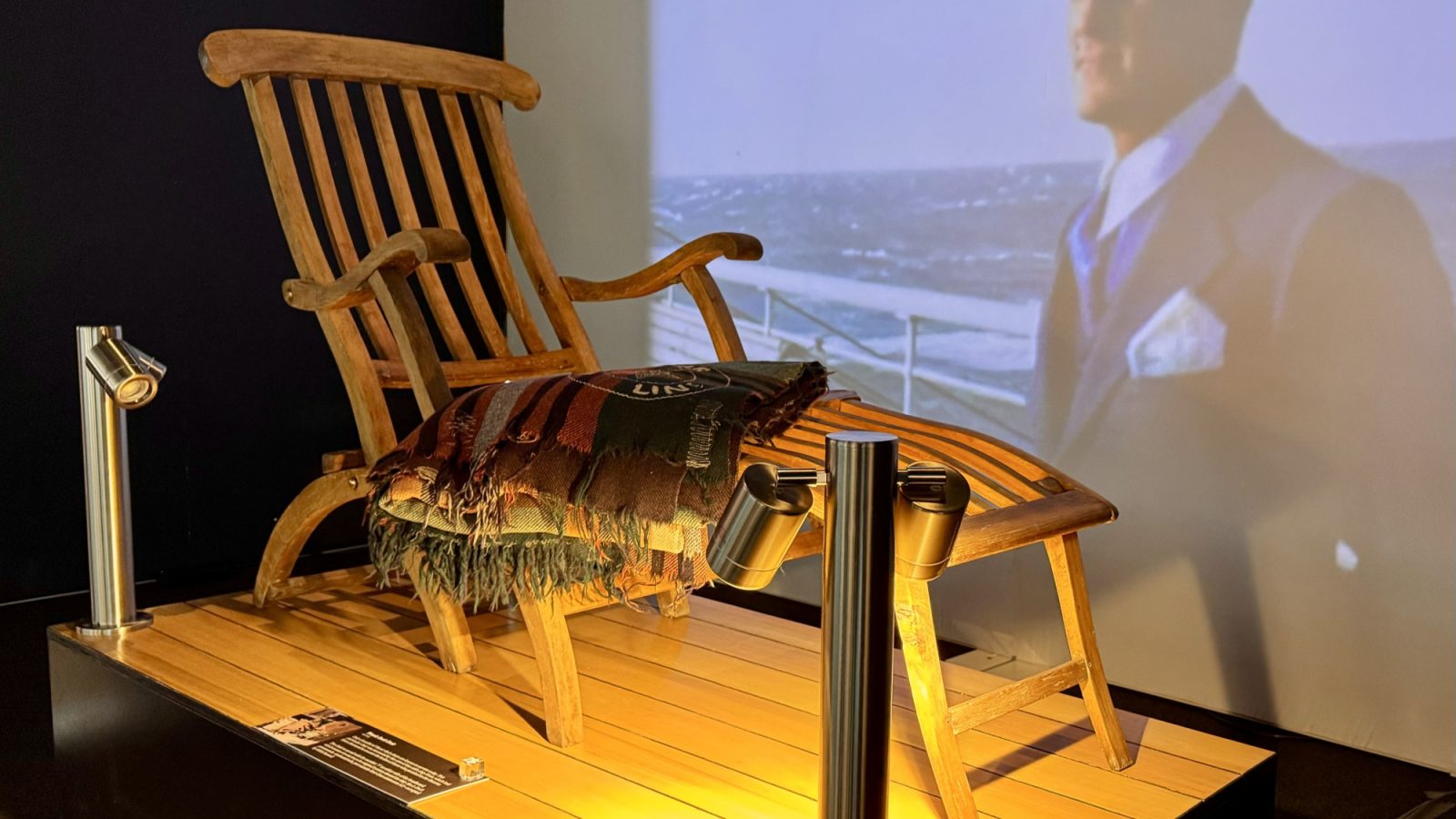
One of the Last Surviving Titanic Deckchairs
Also on display is one of the very few surviving deckchairs from Titanic, an object strongly associated with the human drama of the disaster. During the sinking, deckchairs were thrown into the sea and used as improvised flotation aids; only a small number survive today in intact or near-intact condition. This deckchair has never before been exhibited in Scotland, making its appearance in Aberdeen a national first. Outside of Belfast, it remains the only Titanic deckchair currently scheduled to be shown in the UK.
Aft Grand Staircase Fragment and Floating Wreckage Recovered by the SS Minia
The exhibition includes a group of wooden artefacts recovered together shortly after the disaster by the SS Minia, which was dispatched to retrieve wreckage floating on the surface of the Atlantic. Chief among these is what is believed to be the largest surviving piece of the Titanic’s Aft Grand Staircase, a structure synonymous with the ship’s luxury and ambition and serving First Class passengers at the rear of the vessel. The same recovery effort also brought up a number of additional wooden items, including deckchair fragments and a distinctive sliding wooden door believed to originate from the ship’s galley. Retrieved from the surface rather than the seabed, these artefacts remain in notably good condition and together form one of the most coherent surviving groups of Titanic wreckage recovered in the immediate aftermath of the sinking.
Seabed-Recovered Decking Linked to a Lifeboat Davit
Displayed publicly in Scotland for the first time is a section of wooden decking recovered from the ocean floor at the Titanic wreck site. The piece is believed to have originated near the base of a lifeboat davit, the mechanisms used to lower lifeboats during the evacuation. This decking has recently undergone professional conservation, with elements of that work carried out live on public display. Unlike artefacts recovered in 1912, the decking offers a stark reminder of the material that remained on the seabed for decades before being recovered.
Claire-Lena Miller-Davis, Senior Business Development Manager, Exhibitions and Events at P&J Live, said: “This exhibition has already sold very well, with some peak sessions booked up. The exhibition promises to be engaging, immersive and unique, and we are honoured to be the first in Scotland to showcase some of these special pieces from the Titanic’s fateful journey. This is a must-see event and something truly unforgettable for the whole family.”
To book tickets for the Titanic Exhibition Aberdeen, please visit www.titanicaberdeen.com
For more information on P&J Live visit www.pandjlive.com