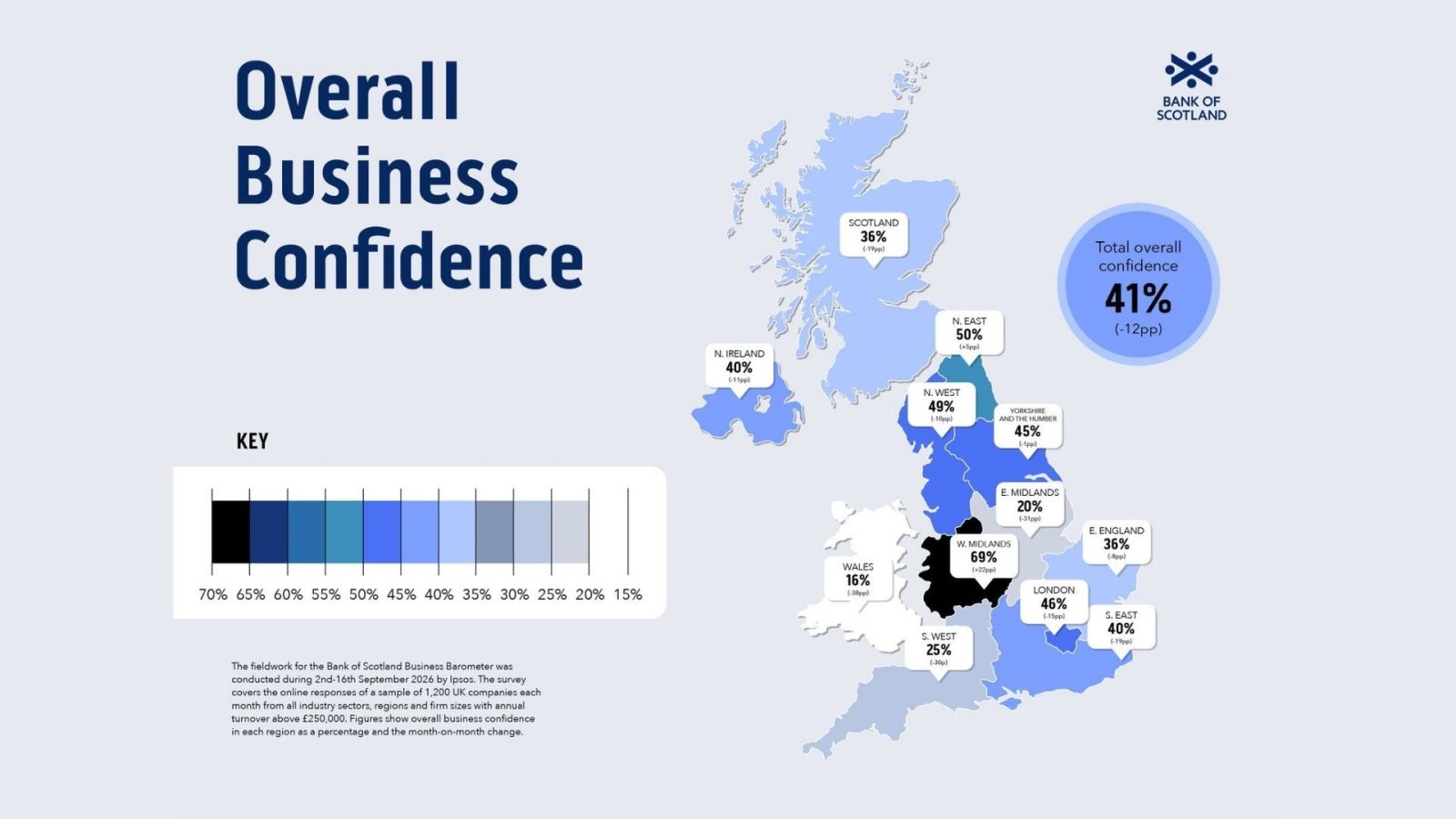
Business confidence in Scotland fell 19 points during September to 36%, according to the latest Business Barometer from Bank of Scotland.
Scottish companies reported lower confidence in their own trading outlook month-on-month, down 15 points at 50%. When taken alongside their economic optimism, down 24 points to 21%, this gives a headline confidence reading of 36% (vs. 55% in August 2026).
But Scottish firms remain committed to growth, with a net balance of 46% expecting to increase staff levels over the next year, up two points on last month.
Businesses are also looking to invest for the future. Over the next six months, 47% of Scottish firms plan to evolve their offering through new products or services, while 45% intend to invest in their teams through training. More than a third (39%) are targeting investment in sustainability - the highest proportion of any UK nation or region.
Business confidence in Scotland now sits below the 12-month average of 46%, with its highest figure this year of 55% in August.
The Business Barometer, which surveys 1,200 businesses monthly and which has been running since 2002, provides early signals about UK economic trends both regionally and nationwide.
Martyn Kendrick, Scotland director at Bank of Scotland Commercial Banking, said: “While confidence has softened, what stands out is that Scottish businesses are continuing to look ahead and invest in the things that will support their long-term growth.
“Almost half are planning to increase staffing levels, while firms are also looking to develop new products and services and invest in their people. Scotland’s particularly strong focus on sustainability is another positive sign that businesses are thinking strategically about how they can build for the future.
“Taken together, that shows a business community that, despite a more challenging backdrop, remains focused on creating opportunities and strengthening its capabilities for the years ahead.”
National picture
Overall, UK business confidence fell 12 points to 41% in September, the lowest level since April 2025.
This decline follows August’s reading of 53%, the second highest recorded this year, and buoyant results since May. While confidence remained well above the survey’s long term average of 30%, it was six points below the 12-month average of 47%.
The overall 12-point decline, which was comparable to the fall recorded earlier this year following the start of the Middle East conflict, was driven by a fall in economic optimism, as businesses responded to higher energy prices as a result of renewed tensions in the Middle East.
Businesses’ own trading outlook declined eight points to 50%, compared to a 12-month average of 56%. The majority of businesses (57% down nine points from August) expect an increase in output over the year ahead, while those expecting a decrease in activity reduced by one point to 7%. Among firms expecting weaker activity, the main drivers were economic uncertainty, higher cost pressures and weaker customer demand.
Amanda Murphy, CEO for Lloyds Business and Commercial Banking, said: “While confidence among larger firms remains strong, smaller businesses have seen a fall in sentiment as they continue to navigate higher costs, inflationary pressures and global uncertainty. Overall confidence remains above its long-term average, and most businesses still expect activity to grow over the coming year, underlining the resilience of UK firms. Ensuring smaller firms can share in future growth will be crucial in the months ahead."