Researchers behind an app designed to support people after skin cancer treatment are inviting former early-stage melanoma patients to take part in its final evaluation tests.
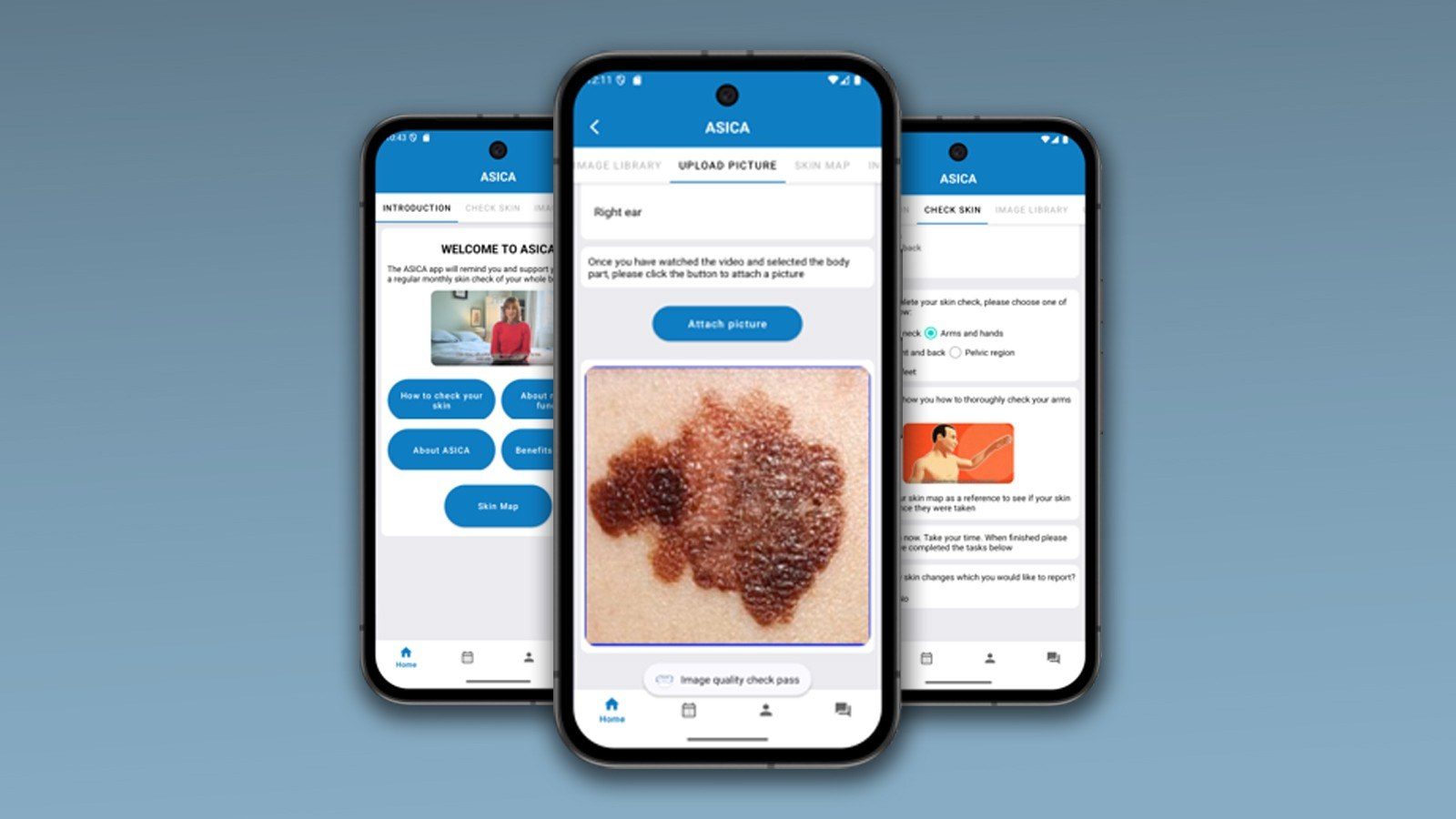
Developed by researchers at the University of Aberdeen and the University of Stirling over a number of years, the Achieving Self-directed Integrated Cancer Aftercare (ASICA) programme has designed the app to help melanoma survivors carry out regular checks of their skin and identify changes which may need further assessment.
ASICA guides users through regular total-skin self-examination and provides support with examining their skin thoroughly.
Where users identify something they are concerned about, the app enables them to record information about the area and provide a report and photograph for review by a healthcare professional.
The research team has now developed ASICA into smartphone versions for both Apple iOS and Android, and is recruiting people who have previously had stage 0–IIA melanoma to take part in the final stage of its evaluation.
This study is funded by Cancer Research UK (CRUK) and builds on an earlier CRUK-funded pilot trial involving 241 melanoma survivors in Grampian and Cambridge. People who used ASICA reported carrying out skin self-examination more frequently, greater confidence in doing so and improved quality of life.
Professor Peter Murchie, Professor of Primary Care at the University of Aberdeen and lead researcher for ASICA, said: “It is very important that people who have had melanoma continue to monitor their skin following treatment. However, we know that people sometimes forget to do this – or only check certain areas - and when a check does find something that causes concern, people don’t always know what to do next.
“ASICA has been developed with people who have experienced melanoma, alongside clinicians, psychologists and computing scientists, to provide practical support.
Effie Marathia, a Research Fellow at the University of Stirling said: “We have been developing and evaluating ASICA for a number of years, so reaching the point where we now have versions available for both iPhone and Android devices is a really important milestone.
“We are now looking for people who have previously had stage 0–IIA melanoma to help us with this final phase of the research. Their experience of using the app will be extremely important in helping us understand how well it works in everyday life and how it could be improved further.”
Participants will use the ASICA app over 6 months and will be prompted to carry out regular total-skin self-examinations. The researchers will examine how people use and experience the app and will seek feedback to inform its final development.
People interested in participating can find more information by contacting asica@abdn.ac.uk.