When Professor Pete Edwards was asked, during his first days in office in November, what his ambition was as principal of the University of Aberdeen, his answer came as a single, uncompromising word.
Excellence.
“Because if we’re not excellent, why are we here?”
It was a characteristically direct statement from a leader stepping into the role after nearly four decades at the institution.
Edwards first joined the University in 1988 as a postdoctoral researcher in Computing Science, specialising in AI and scientific reasoning.
By the time he assumed the principalship in November, he had published more than 170 papers, raised over £20million in external research and innovation funding, and played a key role in major regional bodies including the North East Scotland Investment Zone Working Group, the Regional Inward Investment Forum and Aberdeen City Council’s Community Planning Board.
Few new principals have arrived with a deeper understanding of both the university and the region it serves.
“I’m thrilled to be stepping into the role,” he reflected as he began his first week.
“Aberdeen is a wonderful university with a rich history, an outstanding record of achievement and a lot of truly talented staff and students.”
A global outlook from the outset
Edwards’ first major act as principal was to progress one of the university’s most ambitious international developments to date.
Just days after he formally took office, the university’s Finance and Resources Committee approved the joint venture agreement for establishing a new campus in Mumbai. The agreement puts the university on track to welcome its first cohort of students in India in September 2026.
“Those students in Mumbai will essentially get the same curriculum they would get here in Aberdeen,” he said. “Higher education is now a global game.”
The new campus joins the university’s established operations in Qatar and southern China, where around 1,200 students are currently registered on Aberdeen computing degrees. Negotiations are already under way for further international partnerships.
For Edwards, however, the Mumbai development was about more than global expansion. It represented an opportunity to raise Aberdeen’s profile across the subcontinent, strengthen academic collaborations and, crucially, attract more students to the North-east itself.
A university rooted in place
Even as he set out a global vision, Edwards emphasised that Aberdeen’s purpose remained deeply connected to the region it has served since 1495.
Nowhere is that more evident than at Foresterhill, where the university will begin marking the site’s centenary next year.
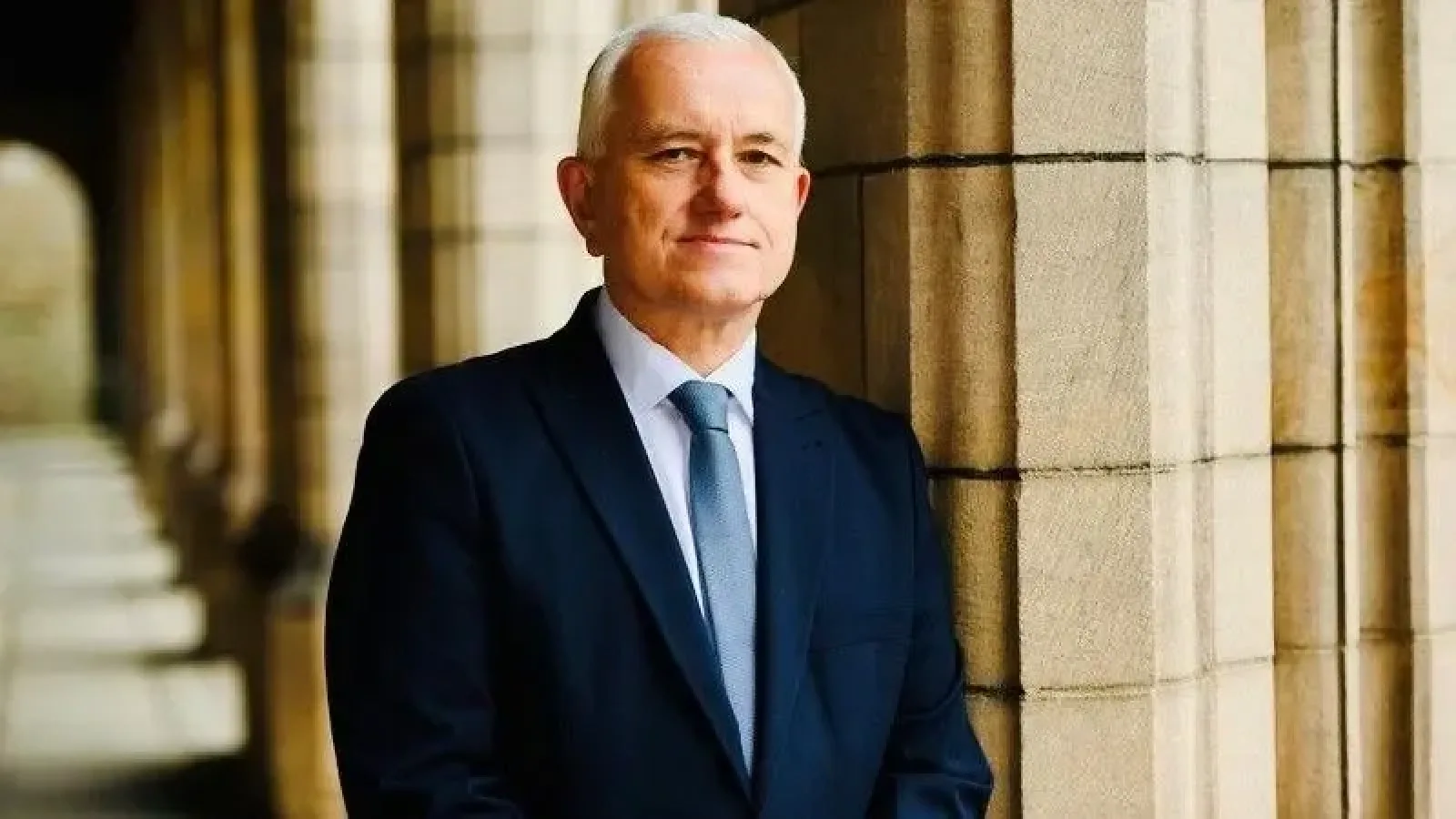
Prof Pete Edwards
“From the outset it was a joint enterprise between the University and the city,” he said. “The medical school has the potential to be a real powerhouse in research as well as in teaching.”
Recent Scottish Government investment has seen first-year medical intake grow from around 180 to more than 300 - a transformation Edwards described with pride.
“Our medical student numbers skyrocketed. We’re training a lot more young medics - one of whom is my own son!”
Taking over in a time of transition
Edwards succeeded Professor George Boyne, who retired at the end of October after seven years at the helm. For Boyne - who grew up in Aberdeen, studied in Aberdeen, and returned decades later to lead it - the moment was bittersweet.
“I finished with horribly mixed emotions,” he reflected. “I’m pleased to have served around seven and a half years, but I was sorry to be leaving Aberdeen for the second time. It felt like the right moment to hand this on.”
Boyne’s tenure spanned extraordinary upheaval: Brexit, Covid and a dramatic fall in international student numbers triggered by UK Government restrictions.
“We lost half our international postgraduate taught students in about 18 months. Around £25 million was wiped out. We had to replace that income, restabilise and recalibrate.”
In response to those pressures, the university’s international model was transformed. When Boyne arrived, Aberdeen taught only around 150 students overseas; by the time he departed, that figure had risen to around 1,500, laying the groundwork for Edwards’ Mumbai focus.
Boyne also spoke passionately about the university’s relationship with its home city. “The University of Aberdeen is an institution for the north-east and of the north-east. People here are intensely proud of it.”
Transforming for the decade ahead
Now Edwards inherits the major change programme Boyne began - one that will define the university’s next decade.
“It’s about asking whether we are fit for purpose and how we deliver transformational change,” he explained. “
The strategy to 2040 is bold and ambitious. My job is to steer the university so we’re in the right shape to deliver it.”
His guiding principle remains the same: excellence.
“When I look at the transformation programme, the lens I apply is very simple: are we excellent at this, or do we have a clear route to being excellent? If not - why are we doing it?”
As the university enters this new chapter - with a new Principal, global expansion underway, and a century of the Foresterhill partnership to celebrate - both leaders share a belief that the North-east deserves a world-class university at its heart.
“That benefits everybody,” Edwards said. “It strengthens the economy, supports public services, and equips our graduates with the skills to thrive.
“That’s what excellence means for this region.”