CyberPrism has announced the launch of CyberPrism Canary, a GNSS subversion detection system designed to help organisations identify when critical navigation and timing data may no longer be trustworthy.
GNSS (Global Navigation Satellite System) is the collective term for satellite-based positioning, navigation and timing systems, including GPS. These systems underpin a wide range of critical sectors including energy, telecommunications, maritime, transport and other industrial operations.
A significant challenge is that most GNSS receivers are designed to provide continuous output, even when signal quality deteriorates. Rather than generating an alert, they often continue to provide their best estimate of time or position, potentially creating a false sense of confidence that the data remains accurate.
In addition, GNSS signals are increasingly exposed to intentional and unintentional interference, including spoofing and jamming. These events can degrade, distort or completely prevent the delivery of accurate navigation and timing data, often without operators being immediately aware.
The consequences of inaccurate timing or navigation data, especially when operators are unaware, can be significant. In energy networks, inaccurate timing can affect synchronisation and switching operations. In maritime environments, unreliable positioning data can reduce situational awareness and increase operational risk.
As incidents of GNSS interference continue to increase globally, CyberPrism Canary provides organisations with independent visibility into the trustworthiness of GNSS-derived data.
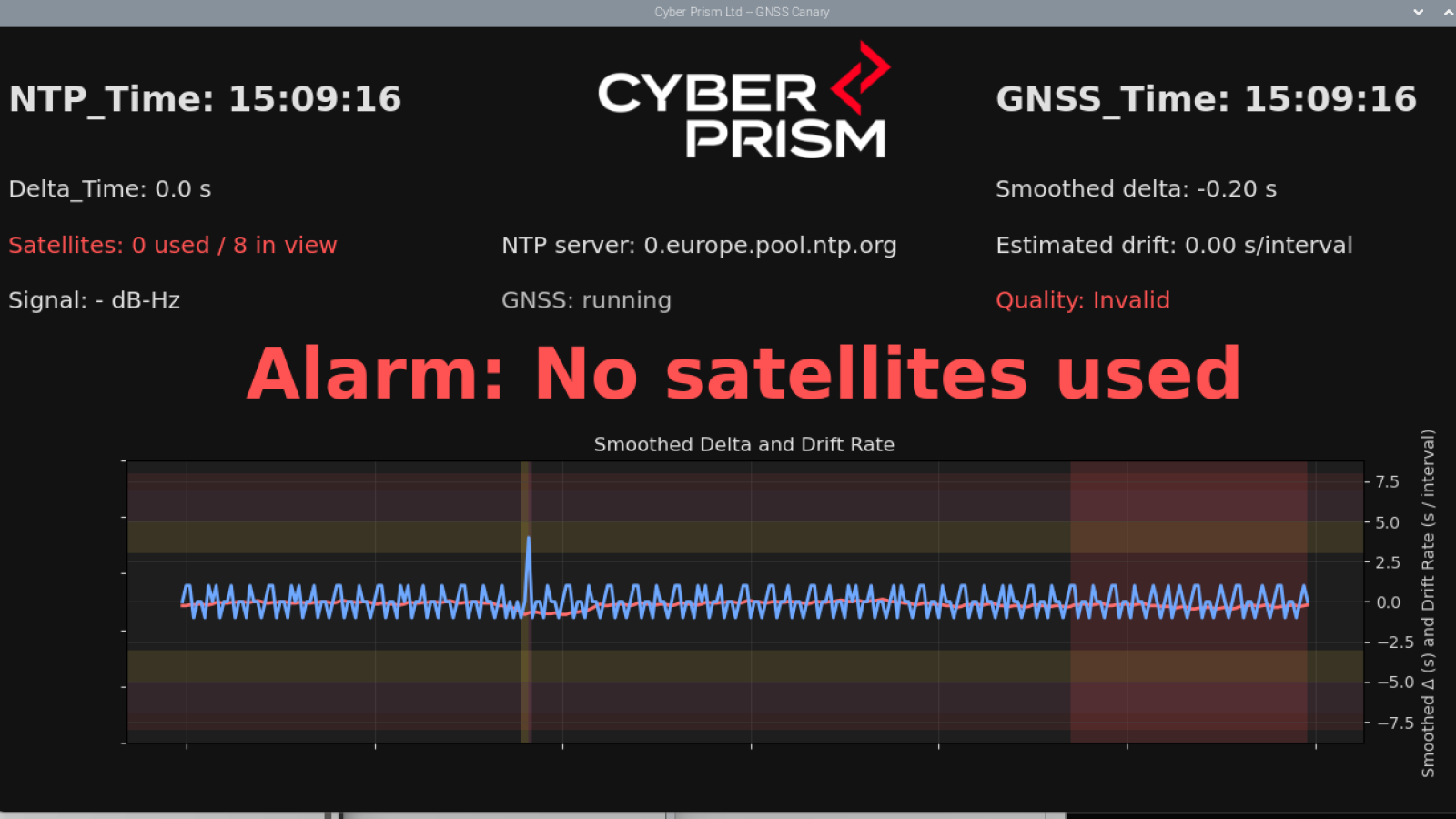
CyberPrism Canary compares GNSS-sourced timing data with independently obtained Network Time Protocol (NTP) time data, using the discrepancies as a reliable indicator of potential GNSS subversion and alerting operators when GNSS-derived navigation and timing data may no longer be trustworthy.
"CyberPrism Canary does not protect against GNSS jamming or spoofing. Our objective is simple: to help GNSS users understand when the data they are receiving can be trusted and when it should be treated with caution.
Many products that claim to be resistant to jamming or spoofing often continue to provide position, navigation or timing outputs by synthesising or extrapolating data, presenting it as though it were still being derived directly from genuine GNSS signals. Our focus is not on masking interference events, but on helping users recognise when GNSS data integrity may have been compromised," said Keith Chappell, Technical Director at CyberPrism.
CyberPrism Canary's core capabilities include:
- Continuous monitoring of data quality, device health and timing accuracy.
- High-visibility alerts that help operators quickly identify signal loss, malformed messages and timing drift.
- A unified operational view of signals, timing data and system status.
- VFC (Volt Free Contact) integration to support automated responses and audio-visual alarms.
- Secure, high-performance log management for evidence capture and audit purposes.
- A flexible modular architecture supporting multiple signal types, power options and logging methods.
CyberPrism Canary has been developed specifically for operational technology environments where reliability, maintainability and clear operational awareness are critical.
To learn more or enquire, visit: https://cyberprism.net/cyberprism-canary/