Farm staff at The James Hutton Institute, Scotland’s pre‑eminent interdisciplinary research institute for sustainable land, crop and nature management, have created two field-size portraits of the Hutton’s namesake to celebrate the tercentenary of his birth.
Born in Edinburgh on 3 June 1726, James Hutton was a farmer, physician, chemist and natural philosopher whose ideas would go on to shape our understanding of the Earth itself. By observing natural phenomena such as soil erosion and rock formations, Hutton concluded that the Earth’s land was formed through a series of continuous, cycles of formation and erosion and therefore had to be far older than previously considered. This idea, which became known as “Deep Time”, laid the foundation for other scientific discoveries, such as evolution and plate tectonics, and cemented Hutton as one of the first earth systems scientists.
His spirit of curiosity and creative science still inspires the work of The James Hutton Institute today, which is why the Hutton’s pioneering farm team set out to create two incredible, field-sized portraits of the Enlightenment thinker.
The portraits, which can be seen from the flight path to Dundee Airport, are located at the Hutton’s Balruddery and Mylnefield Research Farms.
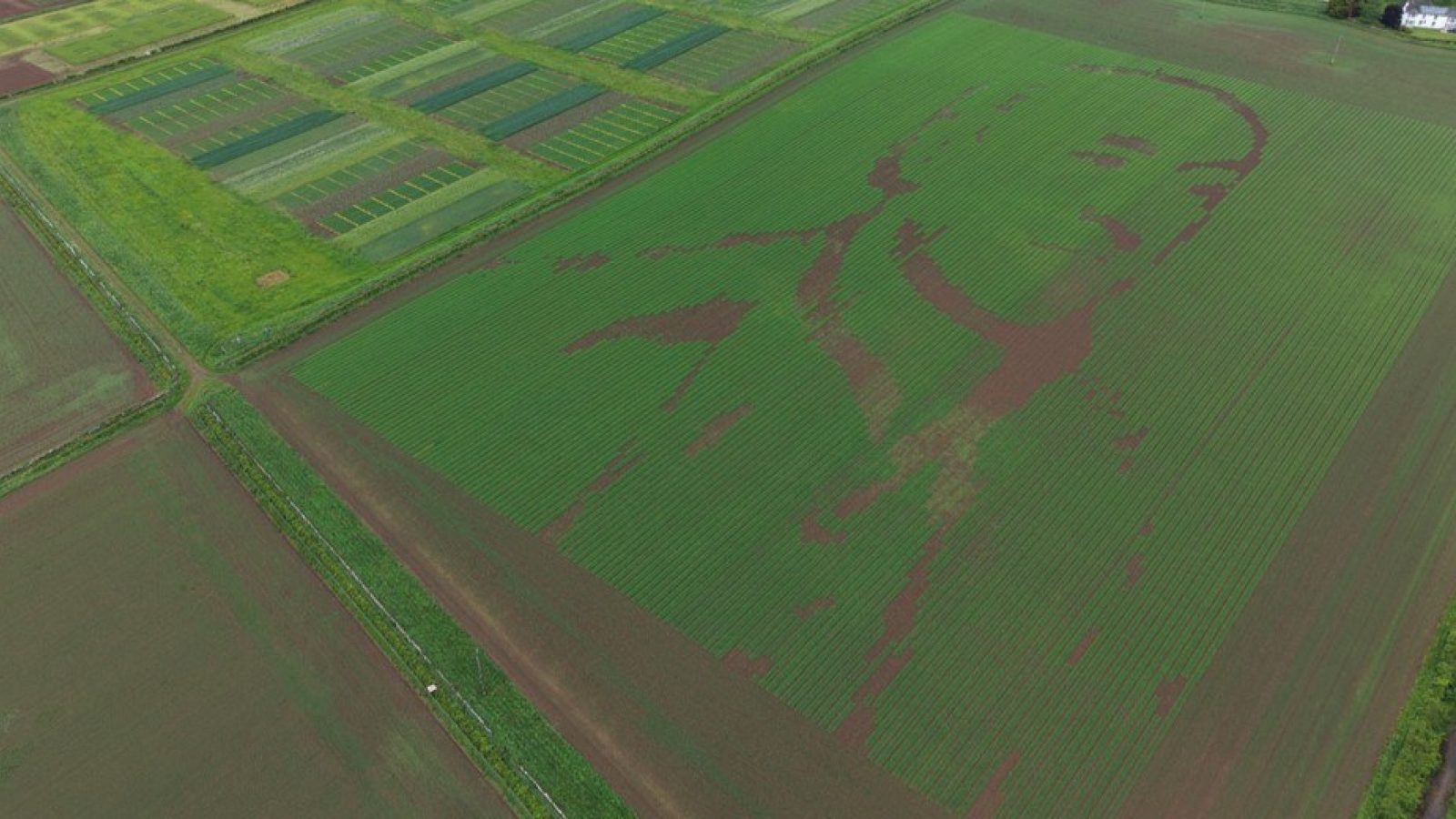
Their creation was led by Field Manager, Andrew Christie, and Head of Farm, Field and Glasshouse, Euan Caldwell. The pair used different methods for their respective portraits in an experiment to see which would yield the best results.
At Balruddery, Euan and his team created the portrait in pixelated form by sowing 27,000 plots of spring barley in a south facing 25-acre field. The team came up with the concept last autumn and contacted Trials Equipment UK Ltd, based in Essex, to see if they could supply a drill to help support our plans.
With support from head office, Trials Equipment Austria Ltd., the UK branch developed hardware and software specifically for this project, which was then installed on the Hutton’s plot drill. This allowed the Farm Team to sow the field in a predetermined pattern, slowly revealing Hutton’s portrait as the crop emerged. The relentless concentration delivered by Derek Matthew, Gabriel Campan and Ewan Findlay was key to this project’s success.
Meanwhile, for the Mylnefield portrait, Andrew used a GPS receiver to follow a digitally-created outline around the field. While following the outline, Andrew sprayed a dark blue industrial food grade dye on the crops, which were then cut away to reveal the portrait.
The two pieces were illustrated in fields of barley – a key research crop for the Hutton. The barley will be harvested and sold as usual.
Together, two portraits stand as a stunning example of the creativity and talent of the Hutton’s farm team, who always embrace new ways of thinking and work hard every day to bring scientists’ ideas to the field.
Professor Colin Campbell, Chief Executive of The James Hutton Institute, said, “Our farm teams are used to being innovative on research and farming practises and have won awards in the past, but they have surpassed themselves on this combining the latest technologies to produce field art this way.
“The portraits are really striking, and we hope people get a lot of fun from seeing them. These pieces have stretched what is possible using modern methods and we have learned a lot from doing it.”