Business confidence in Scotland fell two points during June to 48%, according to the latest Business Barometer from Bank of Scotland.
Companies in Scotland reported lower confidence in their own trading outlook month-on-month, down five points at 57%. When taken alongside their optimism in the economy, up two points to 40%, this gives a headline confidence reading of 48% (vs. 50% in May 2026).
Despite this dip, Scottish firms reported strong customer demand (79%) as the key driver of optimism in the wider economy.
A net balance of 38% of businesses in the country also expect to increase staff levels over the next year, up seven points on last month.
Business confidence in Scotland now sits slightly above the 12-month average of 47%, with its highest figure of 59% in August last year.
Looking ahead to the next six months, Scottish businesses identified their top target areas for growth as evolving their offering, for example by introducing new products or services (48%), introducing new technology such as AI or automation (45%) and entering new markets (39%).
The Business Barometer, which surveys 1,200 businesses monthly and which has been running since 2002, provides early signals about UK economic trends both regionally and nationwide.
Martyn Kendrick, Regional Director for Scotland at Bank of Scotland, said: “While business confidence in Scotland has dipped slightly this month, it remains above the UK average, underlining the resilience and ambition we're continuing to see across the country’s business community.
“It’s particularly encouraging to see hiring intentions rising, suggesting many businesses are looking ahead with confidence despite the ongoing challenges facing the economy. With the busy summer trading period now underway, firms focusing on growth opportunities are investing in the people, products and services that will support their future success.”
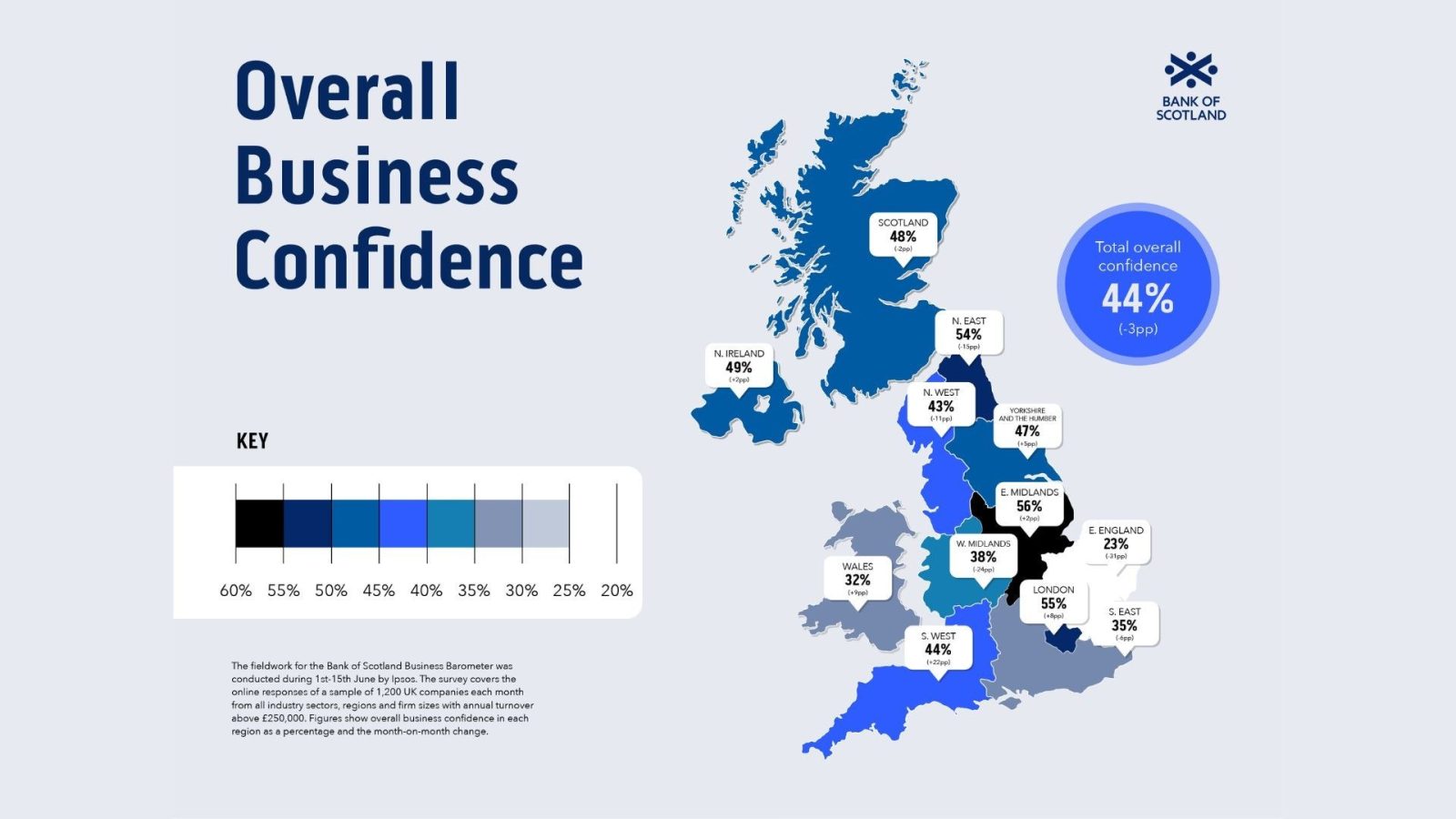
National picture
Overall, UK business confidence fell three points in June to 44%.
Firms’ trading outlook fell two points to 56% and their optimism in the economy generally also fell four points to 31%.
The 12-month average for overall confidence is currently sitting at 47% and is trending above the long-term average of 30% since the survey began in 2002.
Despite a modest softening in business confidence due to wider global uncertainty, two thirds of firms nationally (64%) expect stronger output over the year ahead and hiring intentions for the coming twelve months strengthened for the first time since March.
The share of firms planning to increase their workforce rose to 55%, while 14% anticipated headcount reductions, leaving the net balance up five points at 41%. Firms intending to hire cited the need to meet strengthening demand and expand capacity, pointing to a degree of confidence in near-term activity.
Business confidence rose across six of the twelve UK regions and nations in June, with the South West seeing a 22pp jump to 44%, and the East Midlands becoming the most confident region with a headline confidence reading of 56%.
Amanda Murphy, CEO for Lloyds Business and Commercial Banking, said: “Confidence has edged down this month, and that reflects what we’re hearing directly from businesses. Many are still dealing with a mix of higher costs, uncertain demand and a wider global backdrop that feels difficult to read.
“That is weighing on decision making, particularly for firms that are focused on the UK market and have fewer ways to offset those pressures.
“However, this is not a picture of businesses stepping back altogether. Trading outlook remains relatively steady and we continue to see firms looking for new opportunities, even if investment plans have become more cautious.
“Businesses have shown over time that they can adapt in tough conditions, but for many the priority is managing costs and maintaining stability rather than pushing for growth?”