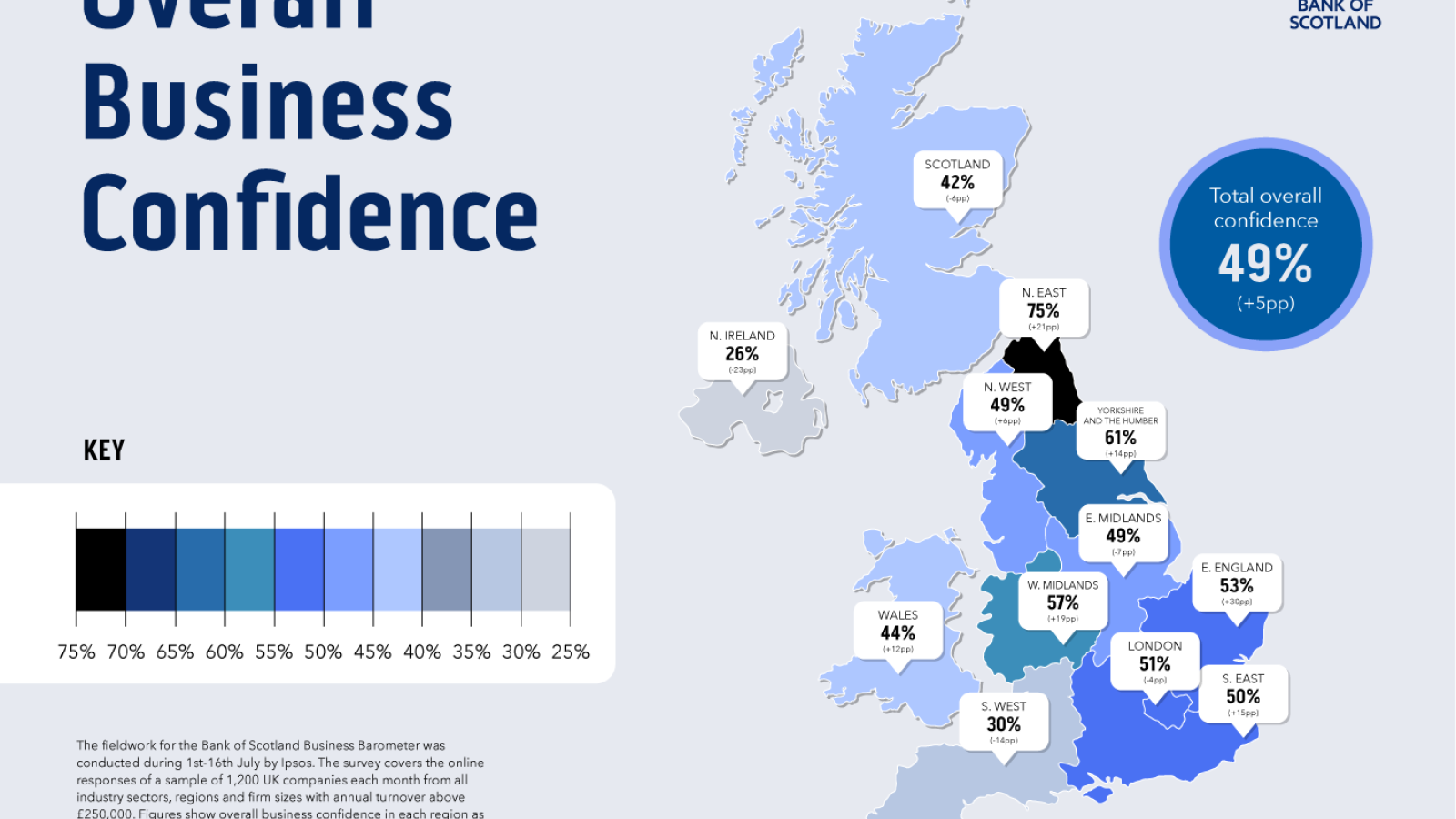
Business confidence in Scotland fell six points during July to 42%, according to the latest Business Barometer from Bank of Scotland.
Companies in Scotland reported lower confidence in their own trading outlook month-on-month, down six points at 51%. When taken alongside their optimism in the economy, down six points to 34%, this gives a headline confidence reading of 42% (vs. 48% in June 2026).
Despite the decline, more than half (51%) of Scottish firms reported continued confidence in their own trading outlook, reflecting some resilience in business operations, though broader economic optimism has weakened to 34%, suggesting caution about the external environment and economic trajectory.
A net balance of 37% of businesses in the country expect to increase staff levels over the next year, down one point on last month.
Business confidence in Scotland now sits below the 12-month average of 47%, with its highest figure of 56% in July 2025.
Looking ahead to the next six months, Scottish businesses identified their top target areas for growth as evolving their offering, for example introducing new products or services (48%), introducing new technology, for example AI and automation (45%), and entering new markets (39%).
The Business Barometer, which surveys 1,200 businesses monthly and which has been running since 2002, provides early signals about UK economic trends both regionally and nationwide.
Martyn Kendrick, Regional Director for Scotland at Bank of Scotland, said: “Business confidence in Scotland softened in July, as firms took a more cautious view of both their own trading outlook and the wider economy. Even so, around half of businesses remain confident, underlining the resilience we continue to see across Scotland’s business community.
“It’s particularly encouraging that so many businesses are looking ahead and planning for growth, with Scottish firms more likely than the UK average to be evolving their products and services and investing in new technologies, showing a strong appetite for innovation. Alongside ambitions to expand into new markets, it's clear many businesses are continuing to invest in the ideas and capabilities that will help drive their future success.”
National picture
Overall, UK business confidence rose five points in July to 49%, hitting a four-month high.
This was driven by an increase in economic optimism, reflecting the decline in global energy prices, the Bank of England holding interest rates and the announcement of an interim peace agreement in the Middle East at the time of the survey.
Optimism in the wider economy rose 11 points to 42%, compared to a 12-month average of 37%. Of those surveyed, 59% said they were optimistic (up four points from June) in the wider economy, while those who felt pessimistic decreased by seven points to 17%. The main factors cited by firms who felt more positive this month were, stronger customer demand, improving interest rates or financial conditions and better economic news.
Businesses’ own trading outlook remained unchanged at 56% in July, compared to a 12-month average of 57%. Sixty-five percent of firms (up one point from June) expect stronger output over the year ahead, while those expecting weaker activity increased one point to 9%. Among firms expecting stronger activity, the main factors were, stronger customer demand, increase investment in capacity or tech and improved supply chain conditions.
Amanda Murphy, CEO for Lloyds Business and Commercial Banking said: “It’s encouraging to see business confidence reach its highest level in four months, driven by a significant improvement in economic optimism. While challenges remain, these results suggest many businesses are feeling more optimistic about the opportunities ahead.
“Businesses have remained remarkably resilient in recent months, with many focusing on investing in their future, improving productivity and making sure they’re well placed to respond as market conditions change. The stronger confidence we're seeing among smaller businesses and firms focused on the domestic market is particularly encouraging, suggesting more businesses are starting to see opportunities for growth and investment.”