An 18th-century Scottish fiddler and composer has been identified as the likely organist who played in the famous premiere of Handel’s Messiah.
A researcher at the University of Aberdeen has uncovered new evidence showing that Charles Macklean, who died in 1745, was part of the small circle of professional musicians surrounding composer George Frideric Handel during his celebrated Dublin season of 1741–42.
Dr Aaron McGregor originally began investigating Macklean because of his connections to north-east Scotland, where he taught and was later appointed master of Aberdeen’s music school. Macklean was already known to scholars of Scottish music as a violinist and composer of Scots tunes and Italianate sonatas, but his wider career and connections beyond Scotland have remained largely unexplored.
Revisiting research first explored during his PhD led Dr McGregor, Lecturer in Music Performance, into a much larger project tracing Macklean’s movements across Scotland, England and Ireland through a wide range of surviving sources.
Central to the discovery was a complex legal petition compiled by Macklean’s wife, Jean Larini, after he abandoned her and she needed to prove the validity of their marriage. The daughter of a celebrated 18th-century acrobat noted for her ability to perform on a rope, Larini belonged to a travelling performance troupe in which Macklean himself appears to have been involved during the early part of his career.
The legal document Larini compiled brought together detailed testimony about Macklean’s travels, employment and personal life, allowing Dr McGregor to connect him with the “Mr M’Lean” or “Mr Maclaine” identified as organist in Dublin advertisements linked to Handel’s performances.
The research also uncovered evidence linking Macklean romantically and professionally with the soprano Christina Maria Avolio, one of Handel’s leading singers. Avolio later appeared in Dublin, where records suggest she performed under the name “Mrs McLean”.
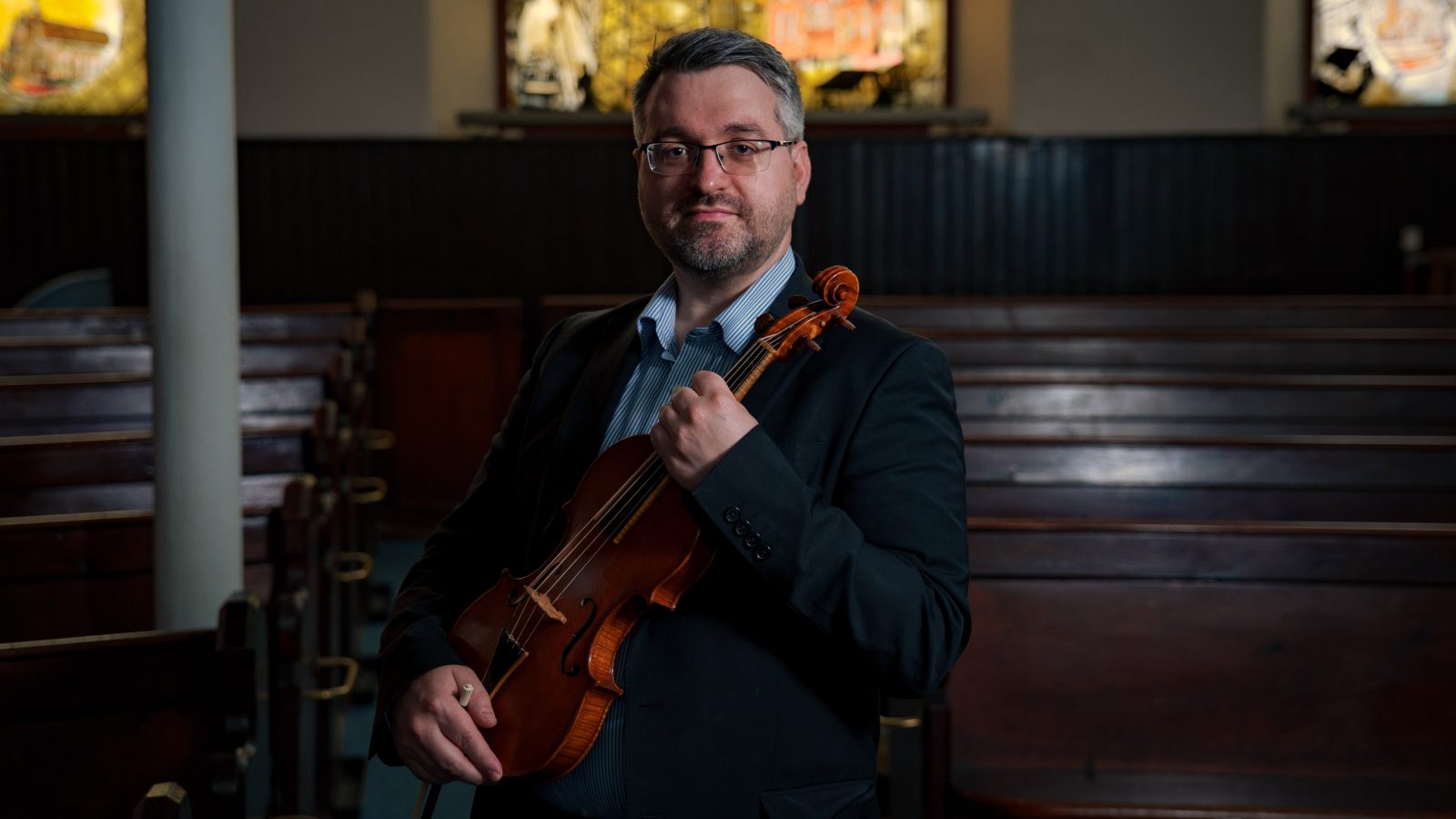
Dr Aaron McGregor (Credit Campbell Parker)
Their connection places Macklean within Handel’s professional circle during the composer’s celebrated Irish season of 1741–42, which culminated in the premiere of Messiah – one of the defining musical events of the eighteenth century.
Dr McGregor said: “Charles Macklean has always been a fascinating but somewhat shadowy figure in Scottish musical history. He appears in north-east Scotland as a music teacher, establishes himself among Edinburgh’s leading musicians, produces some remarkable Scottish fiddle music and publishes a collection of violin sonatas, but then seems to disappear from the historical record. Once I started to delve into the sources, the project grew enormously.”
“Through legal records, parish material, newspaper advertisements and civic documents, a much more substantial figure began to emerge. With his connections with Avolio and Handel, Macklean appears linked to some of the most important musical activity taking place in Britain and Ireland during the period.”
The research traces Macklean’s career from music schools and performance venues in north-east Scotland and Edinburgh to activity in the Midlands, Newcastle, Dublin and eventually London.
At one stage he served as organist at St Peter’s Episcopal Chapel in Montrose, with surviving legal documents and parish records confirming his movements and professional activities. These sources, when cross-checked with divorce papers, provide evidence that Macklean and Christina Maria Avolio were living together in Edinburgh by 1741, with Macklean’s profession recorded as an organist.
Dr McGregor notes that this matches the role described in Dublin, while records of his movements place him among the same networks of performers and patrons connected to Handel.
“The documentary evidence completely reframes Macklean’s biography. He emerges as a highly mobile professional musician whose career crossed Scotland, England and Ireland, moving between theatrical, ecclesiastical and commercial musical worlds,” Dr McGregor added.
“The strong likelihood that Macklean performed in the premiere of Messiah transforms our understanding of him – not only as a figure in Scottish musical history, but as a musician whose career reached the centre of an internationally significant musical event.”
The research also sheds light on the wider musical culture of eighteenth-century Britain and Ireland, showing how musicians built careers through travel, patronage and professional networks rather than permanent institutional positions.
Macklean’s surviving music blends Italianate baroque influences with Scottish traditional material, reflecting a musical culture in which styles and traditions frequently overlapped.
Dr McGregor has completed a scholarly article on Macklean’s life and work. The research also informs a performance at the Glasgow Barons Early Music Festival, taking place at Govan Old Parish Church on 24 July. The performance will launch the new early music ensemble The Curious Collection, featuring Dr McGregor on violin alongside soprano Mhairi Lawson, cellist Alison McGillivray, and harpsichordist William Cole.