The James Hutton Institute and Abertay University have partnered to create a new online game exploring how potatoes have shaped Scotland’s food and farming, alongside the importance of biodiversity and sustainable agriculture.
Working closely with researchers from the Hutton, the student team from Abertay’s Professional Masters in Games Development (Mrof), designed and built Potato Expedition: 1946 earlier this year as part of the Applied Games and Research Design module.
The game places players in the role of a plant collector travelling to South America to gather wild potato species. Their mission is to safely return 20 unique specimens to help establish the Commonwealth Potato Collection (CPC), a vital resource for breeding crops that can withstand disease and climate change
The CPC, held in trust by the Hutton, comprises around 1500 accessions (distinct samples of potato seeds that represent cultivars, breeding lines or populations, maintained for conservation and use in research and breeding) of about 80 wild and cultivated potato species, each of which can be traced back to a handful of berries or tubers from potato plants in south or central America. This gene bank protects future potato food security through genetic diversity.
Gaynor McKenzie, curator of the CPC, said: “Working with Abertay University Games Lab and its students has given our team the unique opportunity to highlight the importance of biodiversity and its preservation to a wide audience. Although this project was in an entirely different area of work for me, I greatly enjoyed collaborating with the students, whose enthusiasm, creativity, and professionalism were evident throughout. They delivered a final product that captured exactly what I had envisioned.”
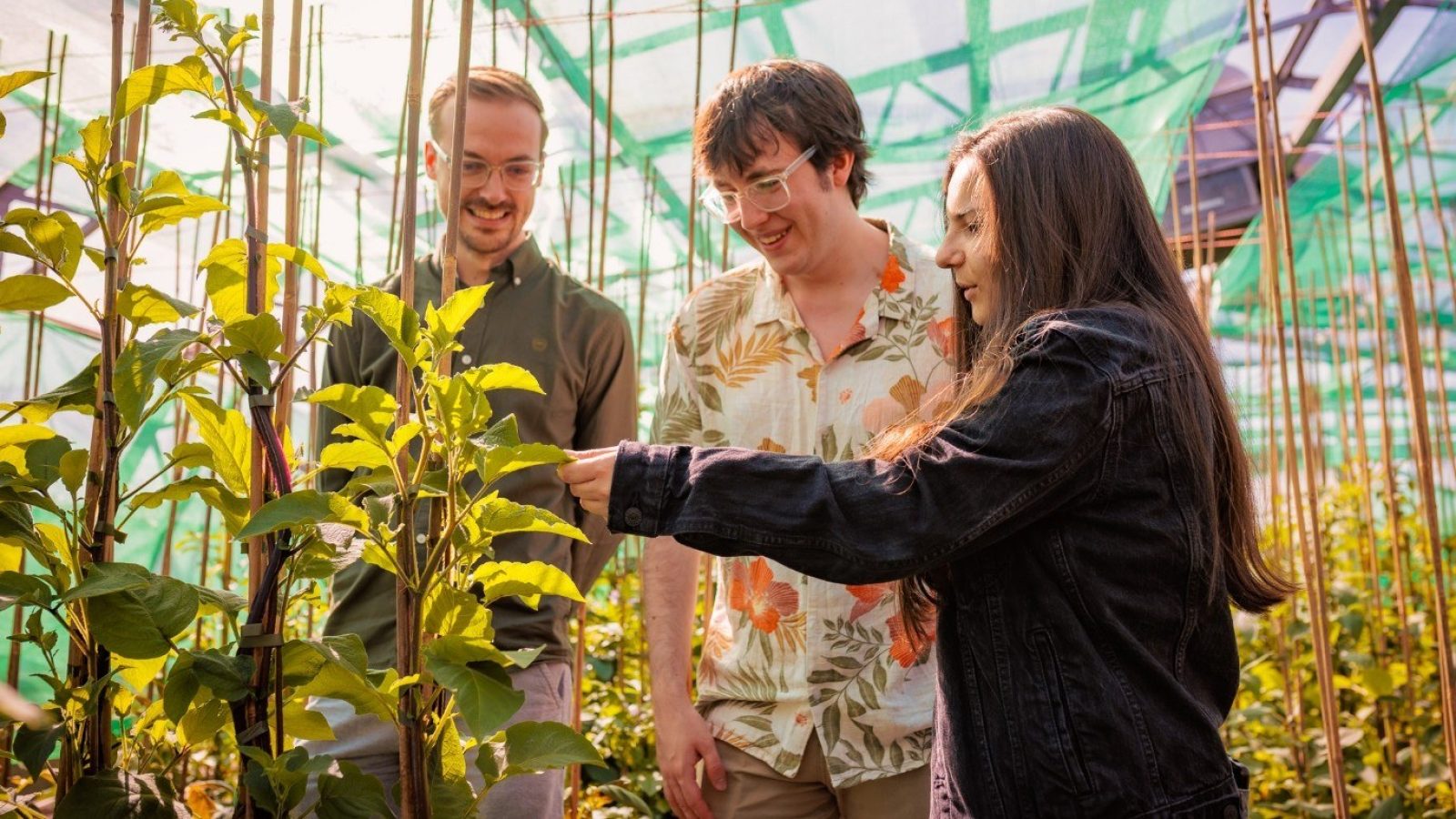
Dr Andrew Reid, Alfie Vaughan and Vera Silva visiting the Commonwealth Potato Collection
Blending storytelling, strategy and puzzle-solving, players must manage limited resources, identify plant species and make decisions in unpredictable conditions. The game is designed to be accessible to a wide audience while sparking interest in biodiversity and the history of food crops.
Vera Silva, a member of Root Games, the team that developed the game, said: “Working with the James Hutton Institute on the game was an incredibly rewarding and enriching experience.
“One of the most fulfilling parts of the experience has been seeing children enjoy playing the game during the visiting school pupils session at Abertay, as well as at the Edinburgh Science Festival, where we were able to showcase the game in partnership with the Hutton.
“Watching the children become curious, engaged and connected with the ideas behind the project was really rewarding for the team and demonstrated the value and potential of games as educational tools. Although the development process was challenging at times, it was absolutely worthwhile, and I’m grateful for the opportunity to collaborate both creatively and professionally with Hutton.”