A national collaboration between the University of Aberdeen and Scotland’s other medical schools, has been awarded £100,000 from the Scottish Government to support the integration of sustainability in healthcare into medical degrees in Scotland.
The global healthcare sector generates around 5% of all greenhouse gas emissions, driven largely by pharmaceutical manufacturing and distribution, staff and patient travel, and the energy required to run healthcare facilities. Waste is another significant contributor. Clinical waste, in particular, carries a far higher financial and environmental cost to process safely compared with general waste, making it an important target for reduction.
This new initiative builds on the recently published Scottish Consortium for Sustainability in Medicine (SCfSiM) white paper, ‘A ‘Once for Scotland’ Approach to Embed Sustainable Healthcare Education in the Undergraduate Medical Training.’ Launched at the Scottish Parliament’s European Network on Climate and Health Education (ENCHE) event in February, the paper sets out a cross institutional approach to preparing future doctors for the health impacts of climate change and the delivery of high quality environmentally sustainable care.
The £100k funding award will support the appointment of a Scottish Clinical Leadership Fellow who will lead coordinated work across all Scottish medical schools to embed principles of sustainable healthcare within medical curricula, in alignment with NHS Scotland climate commitments and the Scottish Government target of net zero by 2040.
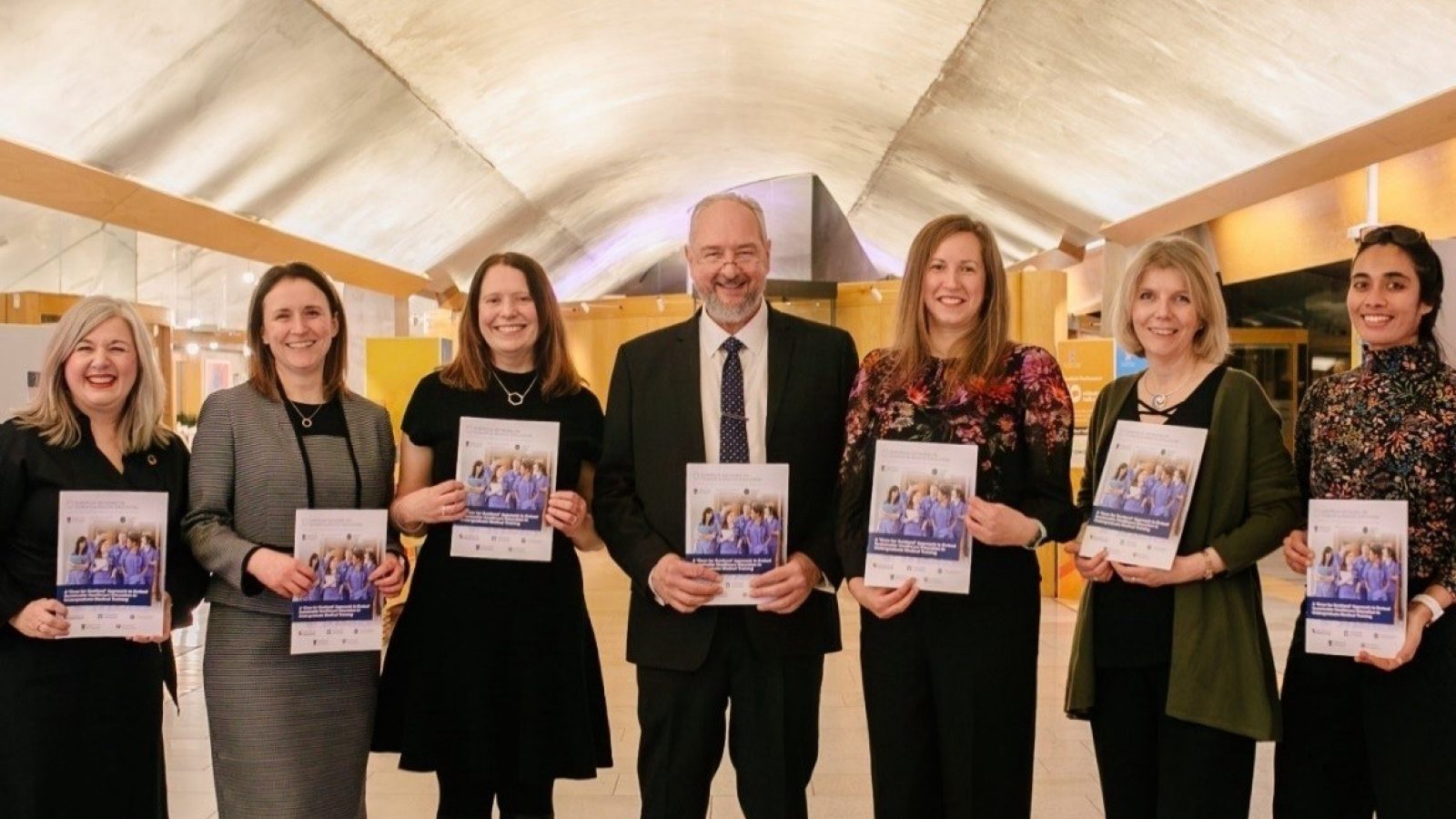
Dr Alison Jack (UK ENCHE representative) and Dr Morven Wilson (ENCHE member), both from the School of Medicine, Medical Sciences and Nutrition at the University of Aberdeen, co-authored the white paper and attended the launch at the Scottish Parliament with colleagues from the other Scottish medical schools. Also present at the launch was fourth year medical student at the University of Aberdeen, Andre Carpio, who presented his research on the awareness of sustainability and the impact of climate change on health within the medical curriculum.
Dr Alison Jack said: “The adoption of the white paper is an exciting and important step towards delivering more sustainable healthcare across Scotland. Through actions such as smarter use of medicines, elimination of unnecessary tests and supporting individuals to remain healthy, we can create a system that will be better for patients, budgets and the environment.
“The collaboration between all five Scottish medical schools has created a powerful network of committed faculty who can make meaningful change together and bring about benefits for patients, stakeholders and the environment on which we all depend.”
Professor David Blackbourn, Head of the School of Medicine, Medical Sciences and Nutrition said: “We are proud to have contributed to this national effort to ensure Scotland’s medical graduates are equipped to meet the realities of climate‑related health challenges. This funding represents a major step forward for sustainable medical education, and we look forward to working closely with our partner institutions and the new Clinical Leadership Fellow.”
Morven Wilson, Director of Teaching (Highland), from the University of Aberdeen said “This funding strengthens the collective commitment of Scotland’s medical schools to place sustainable healthcare at the heart of medical training. By working together, we can ensure every graduate enters the workforce ready to contribute to NHS Scotland’s net‑zero ambitions and to deliver care that supports both population health and the health of our environment.”
The Fellow is expected to take up the post later this year.
Professor Camille Huser from the University of Glasgow coordinated the cross institutional approach. The white paper was authored by Professor Jonathan Issberner (University of St Andrews), with contributions from Dr Emily Stevenson (University of Dundee), Dr Noy Basu (University of Glasgow), Dr Alison Jack and Dr Morven Wilson (University of Aberdeen), and colleagues from the University of Edinburgh.