The latest PMI data for Scotland signalled further decreases in output and new orders in December.
However, workforce numbers broadly stabilised after two consecutive months of decline, while business confidence regarding 2026 remained positive.
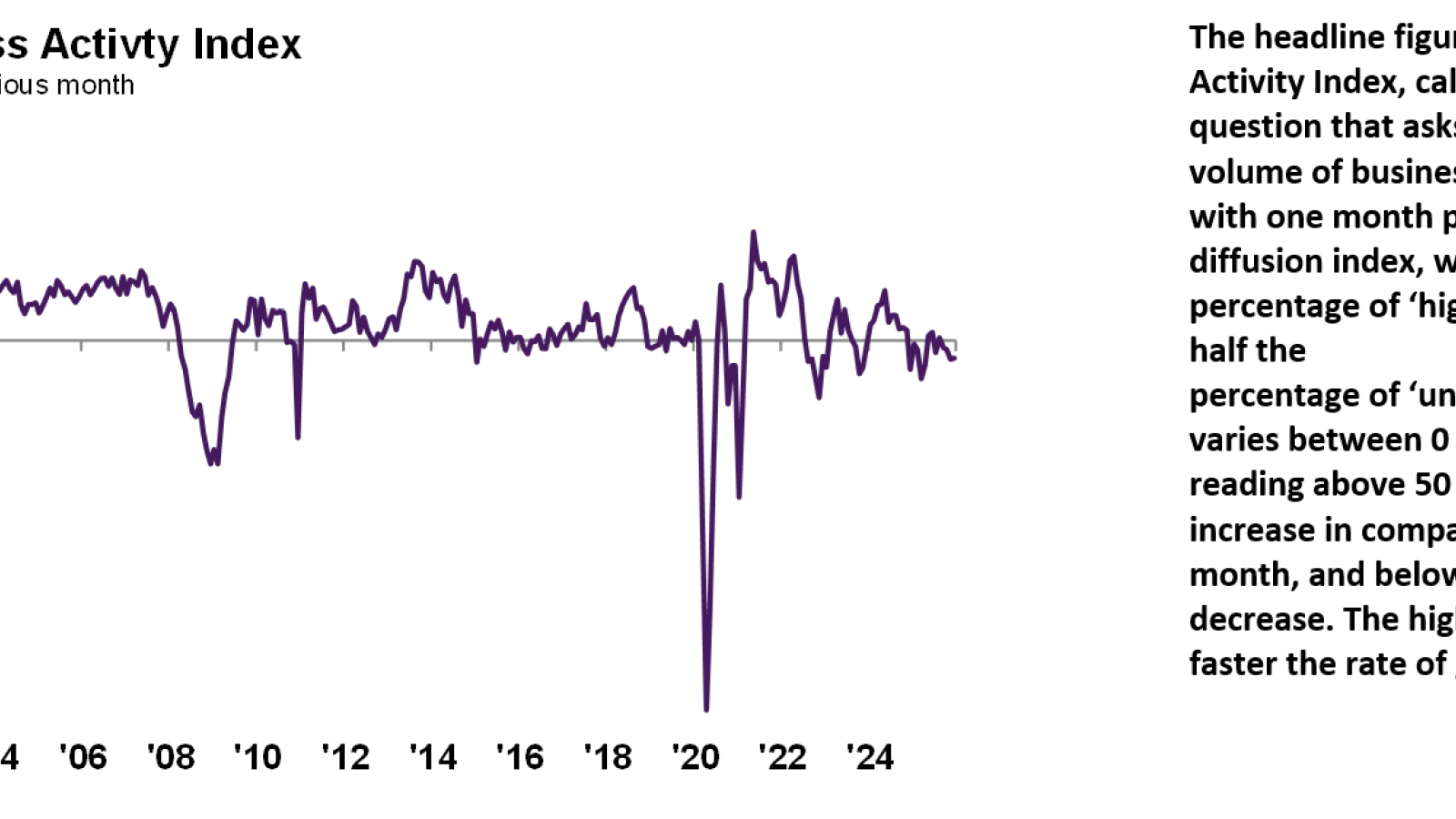
The headline Royal Bank of Scotland Growth tracker– a seasonally adjusted index that measures the month-on-month change in the combined output of Scotland’s manufacturing and service sectors – rose fractionally from 48.0 in November to 48.1 in December, to indicate a fourth successive monthly fall in overall business activity. Companies often attributed the latest decline to falling customer numbers and the rising cost of living.
Following marginal cuts to staff numbers in October and November, the seasonally adjusted Employment Index posted just shy of the neutral 50.0 level in December, to signal broadly stable employment across Scotland's private sector. While manufacturing firms mentioned lowering their headcounts due to reduced requirements, this was largely offset by job creation by service providers, who took on additional staff to replace leavers and increase productivity.
Anecdotal evidence from businesses in December suggest that they remain cautiously optimistic about growth in 2026, with some firms citing new marketing strategies and expansions plans in anticipation of strengthening demand.
Commenting on the Tracker’s findings, Judith Cruickshank, Scotland Board Chair, Royal Bank of Scotland, said: “2025 proved to be a challenging year for Scottish businesses, with the latest Royal Bank of Scotland Growth Tracker data signalling further falls in both output and new business.
“It is clear that inflation is continuing to put pressure on companies and customers. The latest data shows steeper increases in input prices at the end of the year, suggesting that margins are tightening.
“Despite these challenges, Scottish firms remain hopeful that 2026 will be a year of growth. The jobs market also began to stabilise in December after falls in employment over the last two months.”
Performance in relation to UK
The downturn across Scotland contrasted with a mild increase in output across the UK as a whole.
Scottish private sector companies continued to highlight challenging demand conditions during December, as overall new business fell for a fifteenth straight month. The latest decline in sales was the joint-quickest since last March (on a par with last September). According to anecdotal evidence, new orders had fallen due to market uncertainty and tighter client budgets.
Scotland and the North West recorded identical rates of decline in new business that were the steepest of the 12 monitored UK regions and nations. Meanwhile, new orders rose modestly at a UK level.
That said, the level of positive sentiment fell since November and was the second-weakest of the 12 monitored UK regions and nations, with only companies in Northern Ireland less upbeat.
While workforce numbers broadly stabilised in Scotland and the North East, employment continued to fall across the other ten monitored UK regions and nations.
A reduction in new orders enabled companies in Scotland to work through outstanding orders, thereby resulting in a fifth consecutive monthly fall in backlogs of work in December. Despite being the least pronounced in the aforementioned sequence, the rate of depletion outpaced the UK-wide average.
Businesses in Scotland registered a further increase in input costs at the end of 2025. The pace of inflation was the fastest in eight months. Anecdotal evidence frequently linked the upturn to higher wage, supplier and energy costs.
Additionally, only Northern Ireland recorded a faster rate of input price inflation than Scotland across the 12 monitored UK areas in December.
Scottish firms raised their average selling prices in December as firms looked to pass on some of their higher costs to customers. The pace of output charge inflation was solid and stronger than seen in November.
That said, the rate of increase in Scotland was among the weakest of the 12 monitored UK regions and nations, with only Yorkshire & Humber recording a slower pace of inflation.