Stroke patients arriving at Dr Gray’s Hospital in Elgin and Western Isles Hospital in Stornoway are benefitting from the use of innovative new rapid genetic testing devices which can determine whether they are resistant to the routinely recommended drug for stroke patients – Clopidogrel.
National Institute for Health and Care Excellence (NICE) guidelines currently recommend that people who have a non-cardioembolic ischaemic stroke are prescribed Clopidogrel to reduce their risk of having another stroke, but it is estimated that around 28.7% of people are resistant to it.
NHS Grampian consultant in stroke/acute medicine and clinical lead for the project, Petrus Elofuke, explained: “Using a mouth swab which is placed inside a test tube and then into the point of care device, the test can tell healthcare specialists within just 70 minutes whether a patient would benefit from being prescribed alternative antiplatelet medication in the first instance. Clopidogrel is most effective in most patients, but this allows us to best tailor treatment for the smaller group who are resistant to it.
“We are introducing the Genedrive® CYP2C19 ID Kit test as a test of change in Elgin and Stornoway at the same time as samples are sent for lab-based testing. We’ll look at how results compare over the next year. It’s the first time a device of this kind has been tested in remote and rural settings, and we’re extremely proud to be working with colleagues across the two health boards as well as the national Centre for Sustainable Delivery.”
Collette Melaugh, who was recently in the care of the stroke team at Dr Gray’s, welcomed the innovative new approach to supporting patients and said she was delighted with the treatment she received.
“The staff were absolutely brilliant and I couldn’t be happier with the care I received,” Collette commented.
While all health boards have access to laboratories, remote and rural locations sometimes have to transport samples over long distances for specialist tests which can cause delays in receiving test results. This proof of concept project is the first of its kind to be coordinated by the NHS North of Scotland Innovation Hub on behalf of both NHS Grampian and NHS Western Isles.
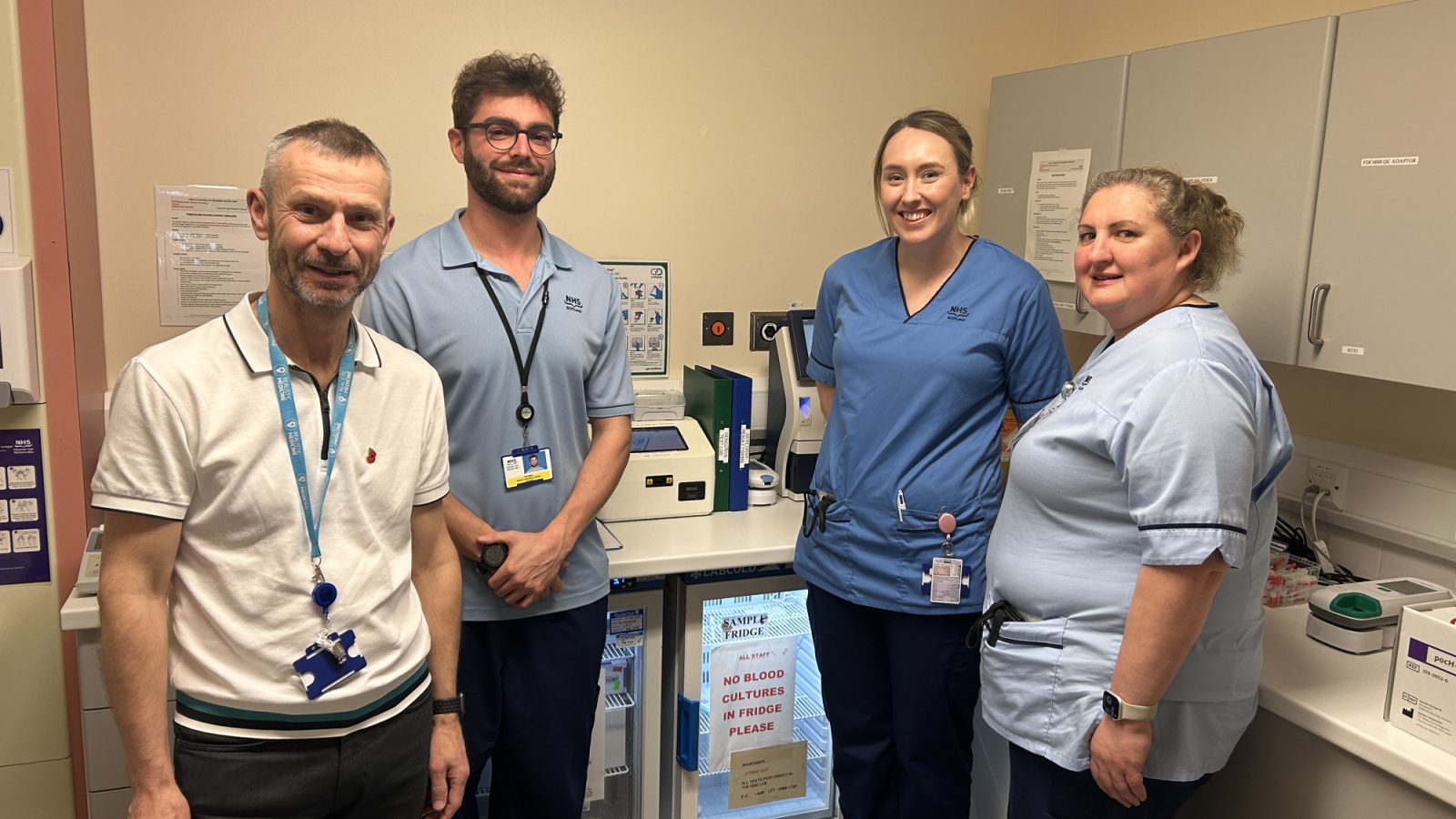
The NHS Western Isles team: Dr Dave Rigby, clinical director for quality, improvement and realistic medicine and clinical lead for the front door services; Ben Millar, laboratory associate practitioner; Mairi Macdonald, community staff nurse; Rona Hilton, healthcare assistant.
Clinical lead for the project in NHS Western Isles, David Rigby commented: “If the devices deliver proven results over the next year, then our project will inform the business case for revolutionising stroke care for remote and rural patients across Scotland. The Genedrive® devices are the size of a small shoe box and are easily accommodated in smaller rural hospitals. We are very pleased to be working closely alongside manufacturers Genedrive Diagnostics Ltd and providing huge benefit to local patients as we make the case for wider use of this exciting new tech.”
NHS Grampian programme manager for innovation, Lorna Cameron added: “This is the beginning of being able to offer more in the way of immediate, precision medicine – ensuring we offer the right treatment at the right time.
“It’s a real collaborative effort and we’re grateful to everyone involved. This includes our nurses and doctors already making use of the new machines, and our labs team in Aberdeen who put the devices through rigorous testing to verify their performance and determine their accuracy before sending them out. Their performance will continue to be monitored throughout the year and the results will also be verified by blood tests sent to our national testing centres. We’re looking forward to sharing an evaluation of our findings with national colleagues.”
Dr. Gino Miele, CEO from Genedrive commented: “We are delighted that the Centre for Sustainable Delivery has chosen to assess implementation of our interventional rapid genetic test solution in NHS Grampian and NHS Western Isles, enabling a precision medicine approach to antiplatelet therapy in these stroke patients in rural settings and, ultimately, better outcomes for patients in these communities.”
Jason White the Head of Innovation in the Accelerated National Innovation Adoption (ANIA) team which is part of the NHS National Centre for Sustainable Delivery, said: “This project is a powerful example of how innovation can directly improve patient care, especially in remote and rural communities. By enabling rapid genetic testing at the point of care, we’re helping clinicians make faster, more informed decisions about stroke treatment. It’s about delivering the right care, in the right place, at the right time and we’re proud to support this collaborative effort through the ANIA pathway."
If you are aware of promising emerging healthcare technology or existing technology with significant evidence gaps that NHS Grampian may be able to evaluate for real world use, please email gram.innovation-hub@nhs.scot